
Mondays usually give me perspective.
“I don’t have time.”
That is one of my general complaints.
But as I wake up on Monday morning, I cannot deny the obvious: I had time.
I had an entire weekend—48 hours available to me.
Yes, I managed to achieve a few significant things during those 48 hours. But even after doing them, I still had time.
As I slowly correct my health behaviour, I also need to start working on a few other areas of my life.
For example, I have kept my JAIIB admission pending for several days. I did not iron my clothes yesterday, even though doing it would have reduced the load this morning.
Why didn’t I do these things?
Because, supposedly, I did not have enough time.
But that isn’t true.
In My Head
I managed to spend a large part of yesterday sulking.
I wasn’t occupied with meaningful work. I wasn’t particularly busy either.
I also couldn’t sleep properly last night, so even those extra waking hours went nowhere.
So where exactly was I busy?
In my head.
The only two significant physical actions I took yesterday were going to the gym in the morning and going to the salon for a haircut in the evening.
For most of the remaining day, I did very little.
And yet, mentally, I felt occupied.
That distinction is important.
There is a difference between being busy and feeling busy because your mind is busy.
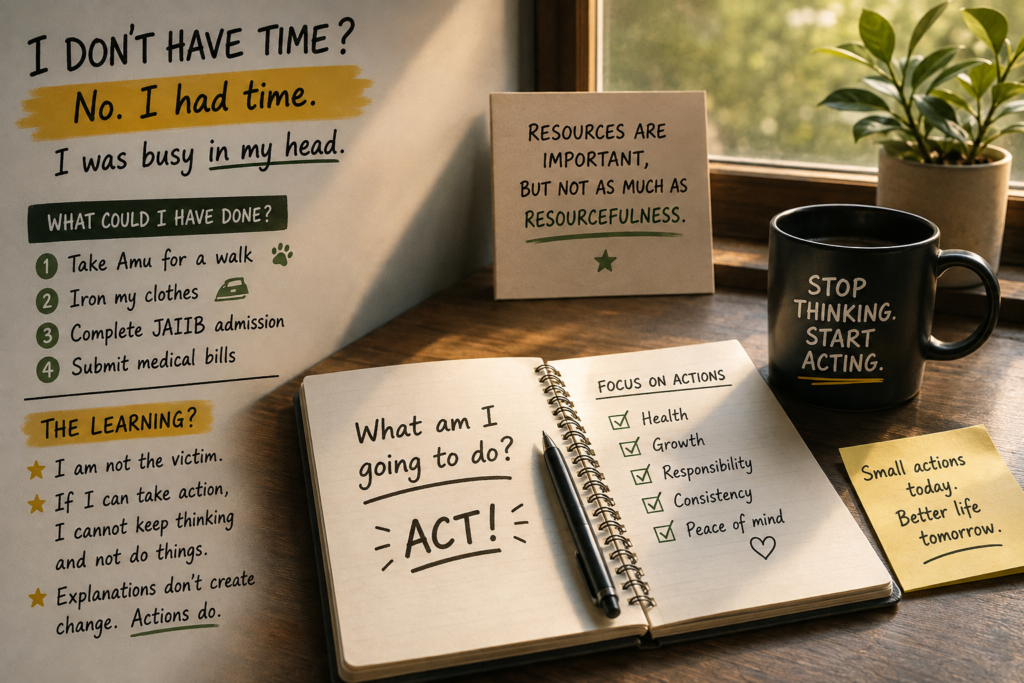
What Could I Have Done?
There were several small things sitting right in front of me:
- I could have taken Amu, my Golden Retriever, for a walk.
- I could have ironed my clothes.
- I could have completed my JAIIB admission, which has been pending for days.
- I could have submitted my medical bills, which have been pending for a week.
None of these required an entire day.
They simply required me to stop thinking and start moving.
Action Bias
I am slowly learning to move away from living entirely inside my head.
I have become more action-biased, but there is still plenty of room to improve.
And that means I cannot casually keep saying:
“I don’t have time.”
It reminds me of a quote I read long ago:
Resources are important, but not as important as resourcefulness.
Perhaps time works the same way.
This isn’t really a time-management problem.
It is an action problem.
A lot of the mental activity that feels like work is simply another form of procrastination. Thinking, worrying, analysing, sulking and mentally negotiating can consume hours without producing a single change in the physical world.
What Is the Learning?
I am not the victim.
If an action is available to me, I cannot keep thinking about it indefinitely and then complain that nothing happened.
I reiterate this for myself:
I am not the victim.
Behaving like one can itself become a form of procrastination. It gives me an explanation for why I haven’t acted.
But explanations don’t iron clothes.
They don’t submit medical bills.
They don’t complete admissions.
They don’t walk the dog.
Actions do.
So what am I going to do?
Act.