A few days ago, I wrote about a skill I don’t have yet: orchestration.
I know how to work. Give me a problem and my instinct is to read more, work harder, follow up and, if necessary, simply take over the task myself.
But I am beginning to understand that this instinct has a ceiling.
This week, my senior repeated a warning he has given me before:
“You don’t have to do the work.”
My job is to get it done.
That distinction is becoming clearer to me.
Owning More While Personally Executing Less
This may be one of the most important operating philosophies I have encountered:
Own more while personally executing less.
Doing less does not mean accepting less responsibility.
It means separating ownership of the outcome from execution of every activity required to produce it.
If something has been entrusted to me, the outcome remains mine.
But that doesn’t mean every Excel sheet must be analysed by me, every person must be contacted by me, every document must be prepared by me or every problem must be personally solved by me.
Instead, I need to ask:
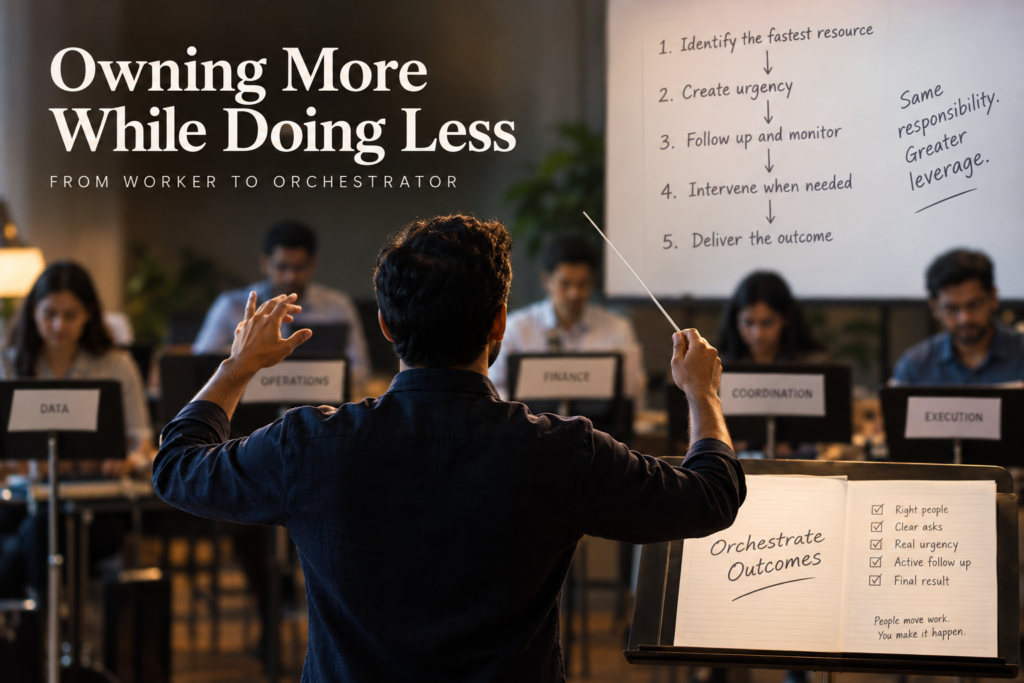
Who can produce this fastest?
That changes everything.
Instead of immediately beginning the work, I first map the resources available to me.
Who has the information?
Who has the expertise?
Who already controls the process?
Who can get access?
Who can actually move this forward fastest?
Then my work begins.
Orchestration Is Not Delegation
Simply forwarding something to another person isn’t orchestration.
If I send a task and quietly wait, I have merely transferred my anxiety to the future.
The real skill is creating movement.
Set the expectation.
Create urgency.
Establish when the output is required.
Follow up.
Monitor progress.
Intervene when something is stuck.
Escalate when necessary.
Inspect the final output.
And ultimately deliver.
This is where I have historically struggled.
When someone doesn’t move fast enough, my instinct is often:
“Leave it. I’ll do it.”
That solves today’s problem.
But it prevents me from developing the ability to operate at scale.
From Worker to Orchestrator
I am beginning to see work differently.
Earlier my operating system was:
Problem → Work → Output
I want to replace it with:
Problem → Identify the fastest resource → Create urgency → Monitor → Intervene → Deliver
My personal labour becomes only one of the resources available to me—not the default resource.
That is a profound change.
Because there is a limit to how much work I can personally perform.
There is a much larger limit to how much work I can cause to happen.
So this is my next experiment.
Before personally executing any important task, I will ask:
Who can produce this fastest?
And once I assign it:
How do I create enough urgency and monitoring to ensure that it actually gets done?
The objective is not to become someone who avoids work.
Quite the opposite.
I want to become capable of owning more while personally executing less.
Because perhaps scale doesn’t begin when I learn to work harder.
Perhaps scale begins when I learn to orchestrate.