Stoicism is awesome, and at this stage of my life, I am beginning to enjoy the fruits of practising it.
I am currently focused on behaviour change. I want to understand how we can eliminate harmful behaviours and adopt healthier ones—and, more importantly, how I can apply those ideas to my own life.
The more I experiment with behaviour change, the more I realise how difficult it is.
Habits do not really change unless something deeper changes. You can force yourself to follow a routine for a few days or weeks, but lasting change often requires a shift in identity.
Put simply: your habits will not change unless you change.
And as I think about what I have achieved, what I have lost, and what is actually worth pursuing, I find myself moving closer and closer to Stoicism as a foundational philosophy for my life.
One major reason is emotions.
Emotions are essential. Fear, anger, desire, anxiety and excitement all serve a purpose. But unchecked emotions can also become incredibly destructive. They can distort judgment, drive impulsive actions and make temporary situations feel permanent.
Stoicism does not ask me to stop feeling emotions. I don’t think that would even be possible.
Instead, I understand it as learning not to surrender control to them.
So today, I am returning to the Enchiridion—Epictetus’ short handbook of Stoic principles.
I have read these lessons before. But knowing something and living by it are very different things. Some lessons need to be revisited repeatedly.
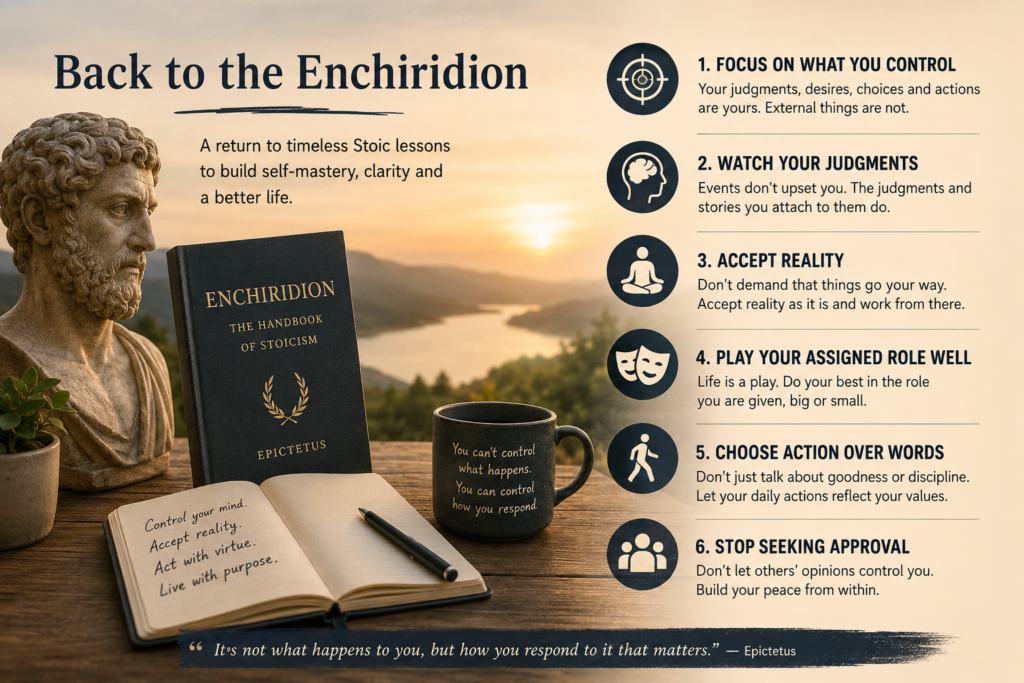
Here are the ones I need to revise today:
- Focus on what you control: Your judgments, desires, choices and actions are yours. Wealth, health, reputation and the behaviour of other people are not fully under your control. Spend your energy accordingly.
- Watch your judgments: Events themselves do not always disturb us. Much of our distress comes from the meaning and judgment we attach to those events. Before reacting, examine the story you are telling yourself.
- Accept reality: Do not demand that reality behave according to your wishes. See things as they are first. Acceptance does not mean passivity; it means starting from reality instead of fighting with it. I wrote recently about my experience with this here.
- Play your assigned role well: Life is like a play, and we do not always get to choose our role. What we can choose is how well we perform it. Whether the role is big or small, temporary or permanent, play it well.
- Choose action over words: Do not spend too much time talking about what a good, disciplined or philosophical person should do. Live it. Your daily behaviour should demonstrate your philosophy.
- Stop seeking approval: If your peace depends on what other people think of you, you have handed them control over your mind. Listen to useful feedback, but do not build your identity around applause or criticism.
These ideas are remarkably simple.
Living them is not.
Perhaps that is why I need to keep returning to the Enchiridion. The purpose is not to finish reading it. The purpose is to slowly make its principles part of my behaviour.
And that, ultimately, is the experiment I am interested in.