My Six Pack in Six Months project is, at its core, a behaviour change experiment.
I adopted this goal because, for me, it has an unusually high upside. If it works, I do not just end up looking better. I build strength, improve my health, reduce weight, and perhaps more importantly, prove to myself that I can deliberately change a behaviour that I have struggled with for years.
The urgency came in March 2026.
I caught a lung infection and had to be hospitalised. The experience was serious enough that I could no longer pretend that my health could remain somewhere at the bottom of my priority list.
But something predictable happened after I was discharged.
The urgency disappeared.
I recovered. Life became normal again. Office resumed. Responsibilities returned. And although I logically understood that I needed to exercise, actually doing it remained incredibly difficult.
There were always perfectly reasonable explanations.
I came home late in the evening, tired and hungry. An evening workout felt physically impossible.
My sleep was inconsistent, and waking up at the so-called correct time was itself a struggle.
There was always some reason why today was not the right day.
That was when I started looking at the problem differently.
Before publicly launching the Six Pack in Six Months project, I studied Behaviour Change Architecture through Coursera and completed a certification. From what I learned, I created a 15-step framework for myself.
You can download that framework here.
Although the framework has 15 steps, most of them revolve around one basic idea:
Only action changes the current state.
There is where I am today.
There is where I want to be.
And somewhere between those two points sits resistance.
Friction.
Noise.
Something prevents the action from happening.
The important shift for me was to stop treating that resistance as external.
For years, I could point towards office timings, workload, traffic, tiredness, responsibilities or circumstances. Some of these factors were obviously real. But blaming them did not help me change anything.
So I started asking a different question:
What exactly happens inside me at the moment when I am supposed to act?
That question produced a surprisingly simple answer.
My chair.
I love waking up in the morning, sitting in my chair, opening my laptop and thinking.
I brainstorm.
I write.
I analyse problems.
I create plans.
I try to think my way towards a better life.
There is nothing inherently wrong with any of this. Writing is almost second nature to me.
The problem was timing.
When I was supposed to go to the gym, my instinct was to sit down and think about going to the gym.
When I wanted to improve my health, I would brainstorm about improving my health.
When I had a problem, I would open my laptop and try to solve it intellectually.
Thinking itself had become a form of comfort.
I began observing that comfort more closely.
What does sitting in the chair feel like?
Where do I feel that comfort physically?
What does getting up in the morning feel like?
Sometimes my head feels heavy. Sometimes my body simply wants to remain still. There is a small but noticeable resistance to changing clothes, putting on my shoes and leaving the house.
Then I imagined the alternative.
Getting up.
Changing clothes.
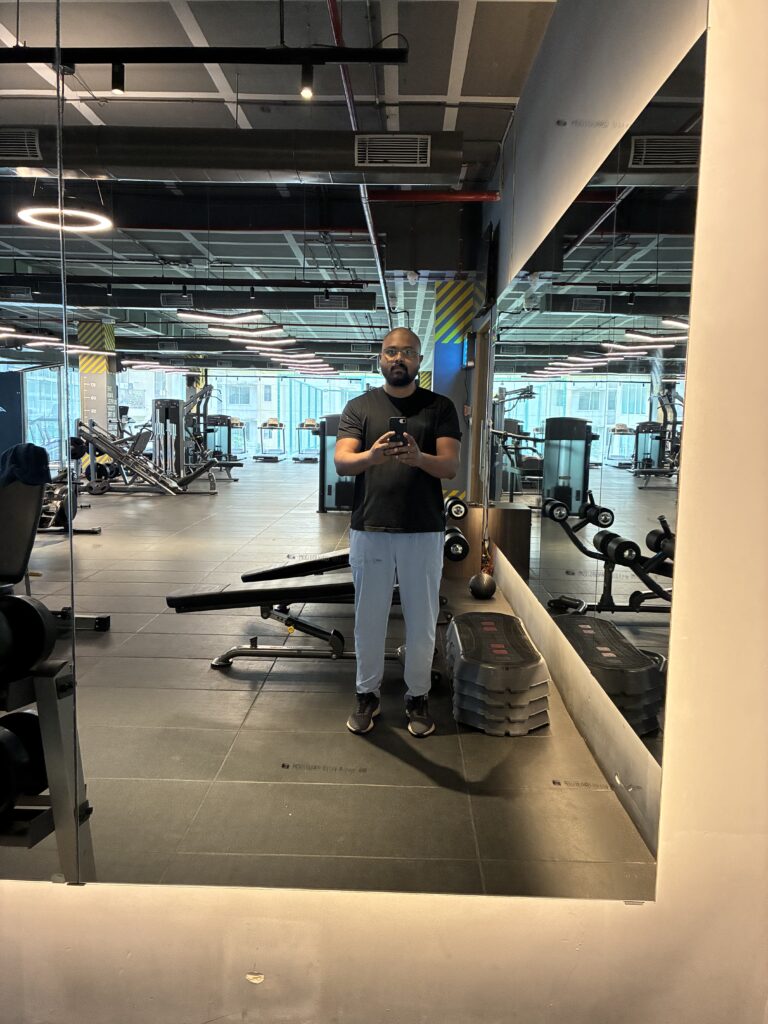
Going directly to the gym.
What would have to disappear for that to happen?
The answer was uncomfortable.
I had to give up some of the identity I had built around being the person sitting with a laptop, thinking deeply and figuring things out.
I needed to become someone who sometimes acts before analysing.
That led to one of the most useful changes in this experiment:
Reduce the distance between decision and action.
Get up and go.
Do not negotiate.
Do not create an elaborate morning routine.
Do not wait until everything feels right.
If I need to brush later, I can brush later.
If I need to use the washroom, the gym has one.
The goal is simply to prevent another unnecessary decision from appearing between waking up and reaching the gym.
This does not mean I have stopped thinking.
Quite the opposite.
I still think a lot.
I still write a lot.
I still enjoy analysing problems.
I have simply started separating thinking time from action time.
During the evening, at the office, or while writing, I can think as much as I want.
But when the predetermined moment for action arrives, thinking is temporarily suspended.
I am not trying to think less in life.
I am trying to think strategically—and not think when thinking merely delays an action I have already decided to take.
Writing has also changed roles.
Earlier, I used writing primarily to brainstorm endlessly and create increasingly elaborate plans.
Now I am trying to use the same instinct to support behaviour.
I write after acting.
I record what happened.
I observe resistance.
I note what worked and what failed.
Instead of using writing as a substitute for action, I am trying to use it as feedback for the next action.
So far, this has helped.
More importantly, it has helped me adopt a behaviour that previously felt unusually difficult to sustain.
But what happens when I fail?
This is where weekly frequency became important.
My target is not to work out every single day.
My target is three workouts per week.
That means failure is already built into the system.
Missing one morning does not mean the experiment has failed.
It simply creates data.
If I miss a workout, I try to understand why.
What was the resistance that morning?
Was I tired?
Did I sleep late?
Did I sit down with my laptop?
Did I start negotiating with myself?
Did I make the workout unnecessarily complicated?
Instead of turning one missed workout into a judgement about my discipline, I try to treat it as information.
Find the resistance.
Make a small correction.
Try again the next day.
That is probably the biggest shift happening through this project.
I am no longer trying to become motivated enough to exercise.
I am trying to understand what repeatedly prevents the behaviour—and then quietly remove those obstacles one by one.
The six-pack is still the visible goal.
But the more interesting experiment is underneath it:
Can I change the way I behave when the moment for action arrives?