
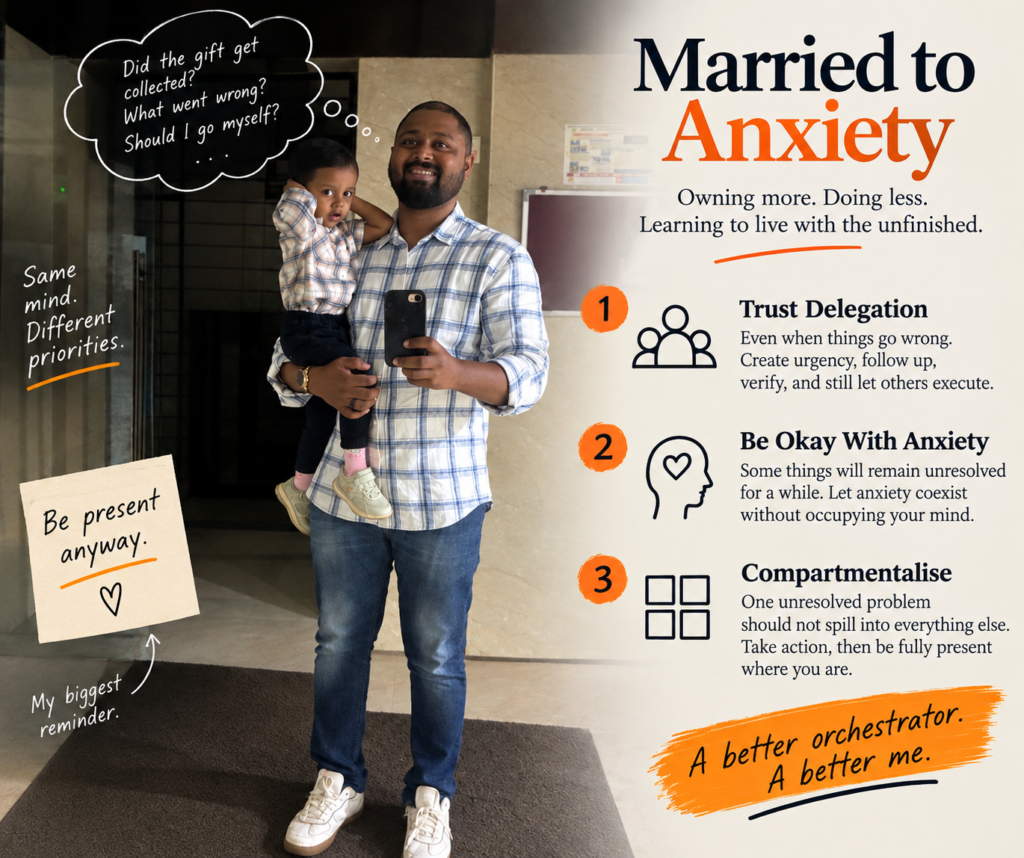
This morning I wrote about orchestration—owning more while personally executing less.
Later in the day, one of my delegated tasks went wrong.
My immediate instinct was predictable: Let me handle it myself.
But that would defeat the entire purpose of learning orchestration. So I resisted the impulse, pushed the person responsible to correct it, and waited.
That waiting taught me more than the successful delegation did.
1. Trust Delegation
Delegation becomes easy when everything works.
The real test begins when something goes wrong. My instinct is to take the task back because doing it myself restores control.
But if I keep doing that, I will always remain a technician.
I have to learn to delegate, create urgency, follow up, verify—and still allow someone else to execute.
2. Be Okay With Anxiety
This is perhaps harder.
Once I delegate, there is a period when the outcome is unresolved and there is nothing useful for me to do.
Yet my mind keeps working.
What if it doesn’t happen? Should I call again? What if something else goes wrong?
Orchestration requires becoming comfortable with this discomfort.
The problem can remain unresolved without occupying my entire mind.
I don’t need to eliminate anxiety. I need to learn to carry it while continuing with everything else.
3. Compartmentalise
This became particularly visible because I was spending time with my son while the problem was being resolved elsewhere.
Physically, I was with him.
Mentally, I kept getting pulled back into the problem.
That is another muscle I need to develop.
An unresolved problem at work should not automatically become an unresolved evening at home.
Take the necessary action. Delegate. Follow up when required.
And then return to the part of life I am actually in.
These three things are difficult for me right now: trusting delegation, living with anxiety, and preventing that anxiety from spilling into everything else.
But perhaps this is the real psychological work behind orchestration.
Own the outcome. Trust the execution. Carry the uncertainty. Protect the rest of life.