
How to deal with nice guy syndrome in High Expectation environment?
Over the last two days, I noticed the same mistake happening three times.
Three different situations. Three different tasks. But my behaviour was almost identical.
And that repetition made me realise that I may have discovered another internal resistance that I need to work on.
The problem is not that I don’t understand what needs to be done.
The problem is that I become too accommodating when another person gives me a reason why it cannot be done.
The First Incident
I had asked a support department to help get a railway ticket confirmed for someone.
The person handling it assured me that he was working on it.
That assurance was enough for me.
I knew the desired outcome was a confirmed ticket. But once someone told me, “I am working on it,” I became comfortable.
I accepted the effort.
I stopped pushing for the outcome.
Eventually, the ticket wasn’t confirmed.
The Second Incident
In another case, I was asked to coordinate with a department and get some officials to come for a meeting.
When I called, one of them explained his situation.
He was waiting to meet his own senior. He had been waiting for some time and was frustrated that he wasn’t able to meet him.
I immediately understood his problem.
In fact, I empathised with him.
But somewhere during that conversation, something changed.
His problem became more important in my mind than the outcome I had been asked to achieve.
Later, my senior was unhappy that the officials had not come.
That made me think.
My empathy wasn’t necessarily wrong.
But I had allowed empathy to become accommodation.
Then It Happened Again
Yesterday evening, my boss needed a car from another support department.
This incident made the problem much clearer.
Instead of communicating the requirement directly:
“PS needs a car.”
I asked:
“Do we have a car here?”
It sounds like a small difference.
It isn’t.
I had converted an instruction into a question.
And more importantly, I had constructed a question to which “No” was a perfectly acceptable answer.
That is exactly what happened.
I was told that a car wasn’t available.
And I accepted it.
I didn’t ask what alternative could be arranged. I didn’t ask whether another vehicle was available. I didn’t ask when one could be made available.
I simply accepted the obstacle.
Three incidents in two days were enough for me to stop treating these as isolated mistakes.
There is a pattern here.
The Nice Guy Problem
I think I am uncomfortable creating meaningful pressure on other people.
I like understanding their problems.
I like being reasonable.
Perhaps, at some level, I also want people to think that I am easy to work with.
There is nothing inherently wrong with any of this.
But it becomes a problem when being understanding comes at the cost of the work I am responsible for.
I am beginning to see another possibility as well.
Sometimes empathy may be giving me a respectable excuse for avoiding an uncomfortable part of my job.
If someone gives me a genuine difficulty, accepting it immediately feels good.
I don’t have to push.
I don’t have to make the second call.
I don’t have to ask the uncomfortable question.
I don’t have to risk irritating someone.
The interpersonal tension disappears.
But so does the outcome.
The sequence seems to be:
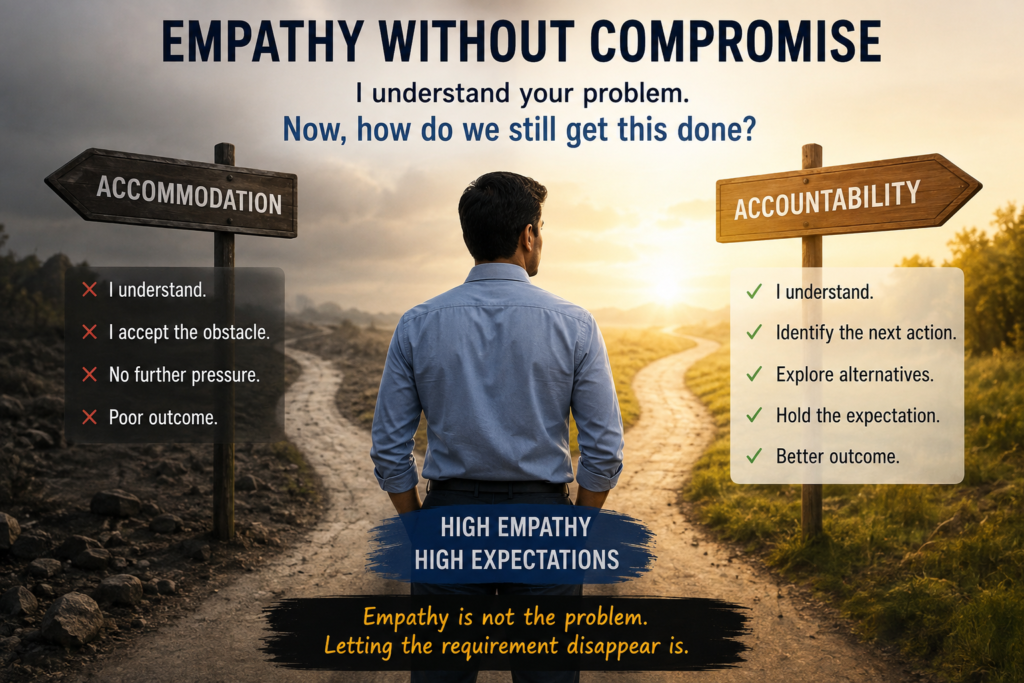
Requirement → Resistance → Empathy → Accommodation → No Further Pressure → Poor Outcome
That is the behaviour I want to experiment with changing.
Why This Matters to Me
One of the reasons I wanted to work closely with senior people was precisely because I wanted to learn this skill.
I am not naturally good at enforcement.
I can analyse. I can understand. I can empathise. I can negotiate.
But can I hold an expectation when another person pushes back?
That is different.
And perhaps this environment is giving me exactly the practice I need.
I Don’t Want to Become Aggressive
My first reaction to discovering this problem could easily be an overcorrection.
Stop being empathetic.
Become demanding.
Tell people what to do.
Push harder.
But I don’t think that is the answer.
The goal isn’t:
Low empathy + High pressure.
I want to experiment with:
High empathy + High expectations.
I can understand why somebody is unable to do something without immediately accepting that the thing cannot be done.
That distinction seems extremely important.
“I understand your problem” does not have to mean:
“Therefore, forget about what I asked.”
Instead, it can mean:
“I understand. So what can we do now?”
The Second Sentence Experiment
I think this is where my next experiment lies.
My first response to resistance comes naturally.
“Okay, I understand.”
I don’t want to remove that.
I want to change what happens immediately afterwards.
I need a second sentence.
If someone says:
“The vehicle isn’t available.”
My second sentence can be:
“Okay. What alternative can we arrange?”
If someone says:
“I am working on it.”
I can ask:
“Great. By when will we know the outcome?”
If someone says:
“I am busy with something else.”
I can respond:
“Understood. When can this be completed?”
If someone says:
“I can’t do it.”
The next question becomes:
“Who can?”
This sounds incredibly basic when written down.
But behaviour change often seems to happen at these tiny junctions.
My problem isn’t necessarily the first sentence.
My problem is that there often isn’t a second sentence.
I hear the obstacle, empathise with the person and allow the conversation to end.
That is what I want to change.
A New Rule
For now, I am going to experiment with one simple rule:
Never accept an explanation without identifying the next action.
I don’t need to argue with the explanation.
I don’t need to prove that someone’s difficulty isn’t genuine.
I don’t even need to become less empathetic.
I simply need to prevent their explanation from becoming the conclusion of my task.
I can acknowledge the constraint while continuing to pursue the outcome.
Perhaps that is what enforcement actually means.
Not shouting.
Not threatening.
Not becoming unpleasant.
But refusing to let the first obstacle quietly become the final answer.
This is not an experiment in becoming less empathetic.
It is an experiment in discovering whether I can retain empathy while becoming much better at holding expectations.
For now, the behaviour I want to practise is very small:
I understand your problem. Now, how do we still get this done?