
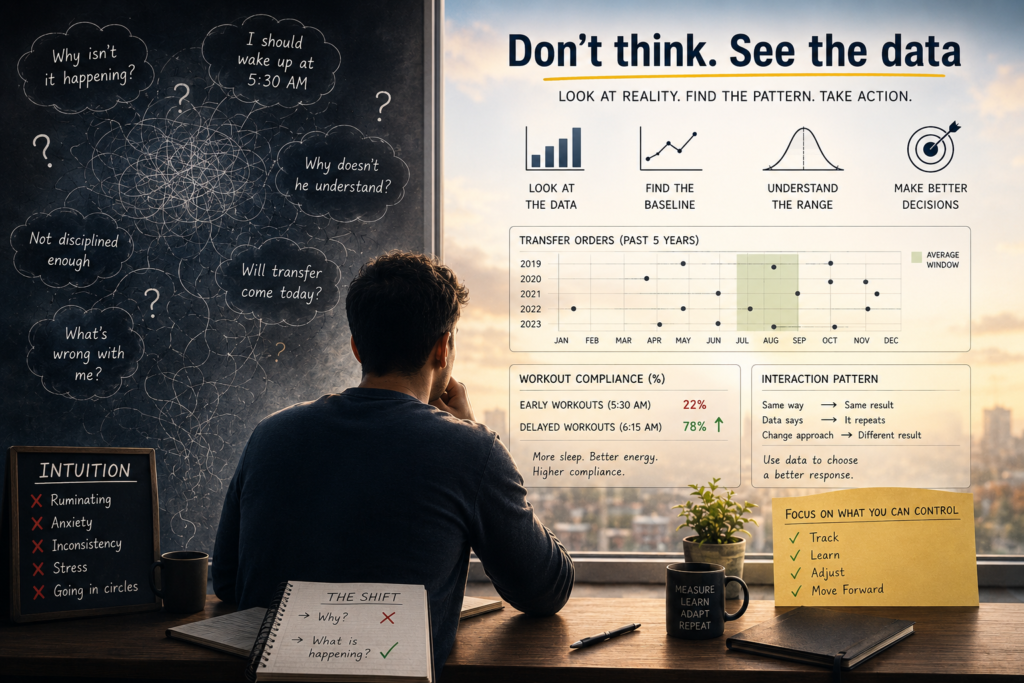
I Am Learning to Look at the Data
For a long time, I operated primarily through intuition.
I would decide how something should work and then try to force reality to comply.
Morning workouts are a good example.
For years, I wanted to be the person who started working out exactly when the gym opened at 5:30 AM.
The problem was simple:
The data never supported it.
Early morning workouts repeatedly collapsed. Instead of questioning the system, I questioned myself.
Why can’t I wake up? Why am I not disciplined enough?
I treated a recurring pattern as a character problem.
My Introduction to Data
I first seriously encountered this idea while reading the work of Amos Tversky and Daniel Kahneman.
Their work challenged our confidence in intuition. Human judgement is vulnerable to biases, distorted memories and misleading narratives. Statistical information and base rates can often provide a better starting point.
I understood the idea.
Then I mostly ignored it.
The Transfer Experiment
The lesson became real during my transfer.
I was obsessed with when the order would arrive.
Will it come today? Why hasn’t it come? What does the delay mean?
Then I looked at when transfer orders had been issued over the previous few years.
Suddenly, I had a baseline.
I still didn’t know the exact date, but I had a reasonable range.
My anxiety dropped.
Nothing had changed externally. The transfer had not arrived.
The only difference was that uncertainty now had data around it.
From “Why?” to “What?”
Since then, I have started changing the question.
Instead of:
Why isn’t this happening?
I ask:
What is actually happening?
My workout history, for example, shows that extremely early workouts have rarely been sustainable.
So instead of forcing myself to wake up earlier, I moved my alarm 45 minutes later.
I slept more, woke up comfortably and went to the gym.
My compliance improved.
My intuition said discipline meant waking up earlier.
The data suggested something else:
If the objective is consistent exercise, optimise for compliance—not an impressive wake-up time.
Eleven Years of Intuition
This also makes me rethink my eleven years in banking.
For most of those years, I relied more on intuition than data.
Targets felt difficult. Business felt slow. Customers appeared uninterested. I responded by thinking harder and stressing more.
What if I had simply tracked calls, customer interactions, conversion rates, business generated and successful customer segments?
Instead of asking, “Why isn’t business increasing?”, I could have asked:
“What does the data say I need to increase?”
I don’t know how different my career would have been.
But I suspect I would have spent far less time ruminating.
Today’s Reminder
I was reminded of this again today after an argument.
This particular pattern of interaction has happened before.
My instinct is to ask:
Why doesn’t he understand?
But if the same type of interaction repeatedly produces the same response, I already have useful data.
The better question is:
Given this pattern, how should I behave differently next time?
Reality does not need to behave according to my expectations before I can adapt.
Predictability Married to Uncertainty
Data does not provide certainty.
Samples can be small. Circumstances change. Outliers happen. Human beings remain unpredictable.
A baseline is not destiny.
But it gives uncertainty some shape.
The transfer might arrive earlier or later than expected. A 5:30 AM workout might occasionally work. A person might respond differently tomorrow.
The future remains uncertain.
But it is no longer completely shapeless.
Data gives me a little predictability married to uncertainty.
For years, I tried to eliminate uncertainty by thinking harder.
Now I am experimenting with something simpler:
Don’t think. See the data.
Measure reality. Find the pattern. Adapt.
My intuition can still have a voice.
It just doesn’t always deserve the first vote.