Treating failure as feedback, behaviour change as iteration, and life as an experiment
BAF — my Behaviour Architecture Framework — is slowly becoming more than something I use for my health project. It is becoming an approach to life.
And for some reason, I am truly enjoying it.
The biggest change is simple: I have removed the absolutes.
Failure is no longer evidence that something is wrong. Failure is feedback. In fact, failure is deliberately built into the approach.
Growing up in a middle-class family in Mumbai, I absorbed a very different idea.
Things should not go wrong.
Our education system reinforced it. Study for the entire year. Learn the syllabus. Appear for the examination. Get your score. Get ranked against everyone else.
You have to pass.
Failure comes with embarrassment, isolation and sometimes even shame. So naturally, the safest strategy is to prepare more before attempting anything.
I don’t think this approach is good for real life.
My natural inclination seems to be iterative.
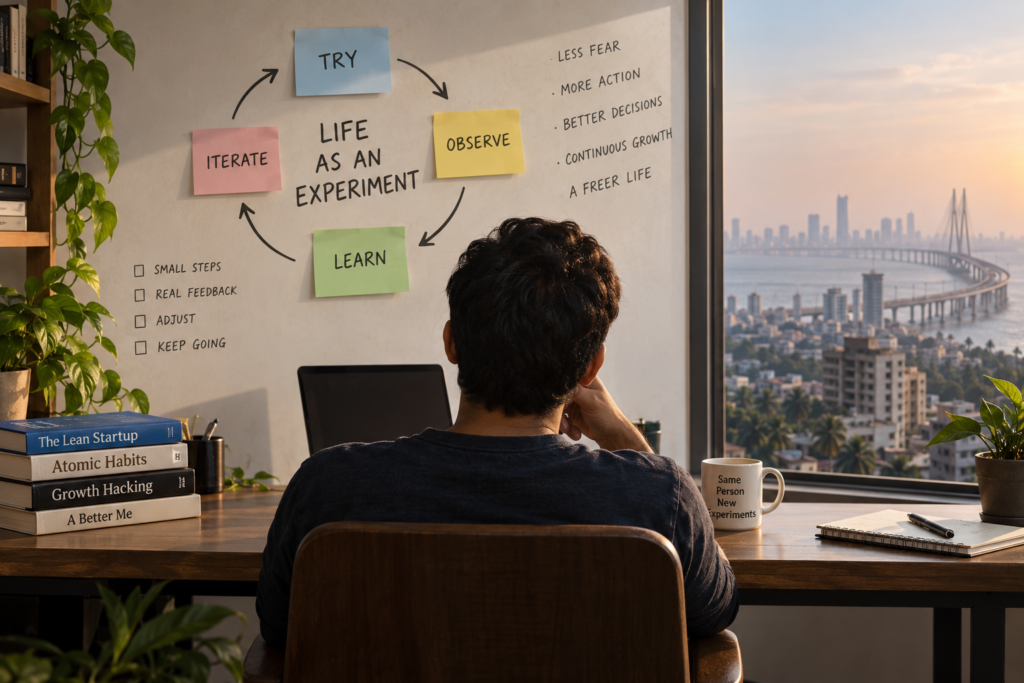
Try. Observe. Adjust. Try again.
Unfortunately, it took me a long time to understand this. I kept believing that I needed to know enough before acting. I needed the complete plan before starting.
Ironically, that desire to avoid failure made me stall.
What if life is an experiment?
I am now trying something different.
Instead of avoiding failure, I want to iterate fast enough to learn from it.
I keep logs as public record.
I record what happened. I change something and run another experiment.
Nothing needs to be absolute.
I am applying this approach to my new job.
If my superior gets angry with me – I look at it differently.
What exactly happened?
What did I do wrong?
What can I change?
I maintain a note called “Mistakes Made.” If something goes wrong, I record it. If necessary, I update my personal SOP so that the same mistake becomes less likely next time. I review this note daily.
The objective is to prevent emotion and ego from interfering with learning.
A mistake becomes data.
And strangely, that feels liberating.
I don’t have to succeed immediately. I only have to keep moving towards the desired outcome through small actions and repeated iterations.
Where did this idea come from?
I first encountered this way of thinking while studying marketing.
The Lean Startup approach introduced me to the idea of a business as a learning mechanism. Instead of spending enormous amounts of time perfecting something before exposing it to reality, you build, measure and learn.
Run experiments. Collect evidence. Adapt.
Later came Atomic Habits, which gave me a powerful way to think about behaviour: small actions, repeated consistently, can produce enormous changes over time.
But I still struggled to apply many of those ideas.
I think I know why now.
I was turning even habit formation into an absolute.
Design the right environment. Create the right cues. Build the right system. Follow the framework correctly.
Then action should happen.
Except sometimes it didn’t.
What I was missing was experimentation.
Then there is another idea I love: growth hacking.
It is an irresistible phrase. Who doesn’t want growth? And who doesn’t want to discover a faster route towards it?
Growth hacking assumes experimentation. Try something. Measure what happens. Keep what works. Discard what doesn’t. Run the next experiment.
That is increasingly how I think about BAF.
Growth hacking applied to lifestyle experiments.
My health project is one example. Instead of repeatedly asking myself why I am not disciplined enough, I can ask a more useful question:
What is creating resistance to the behaviour I want, and what experiment can I run to reduce it?
That small change in perspective has started spilling into other areas of my life.
Work. Health. Writing. Learning.
Perhaps even life itself.
I am aware this approach works. But whether it will work to solve my problems – that is something worth testing.
But so far, something interesting has happened.
When I stopped demanding that every attempt succeed, failure became less frightening. When failure became less frightening, action became easier.
And when life became an experiment, I started experiencing a peculiar kind of freedom.
Nothing has to work the first time.
I can iterate.