For the last two days, I have been in a slump.
And I know what started it.
Beer.
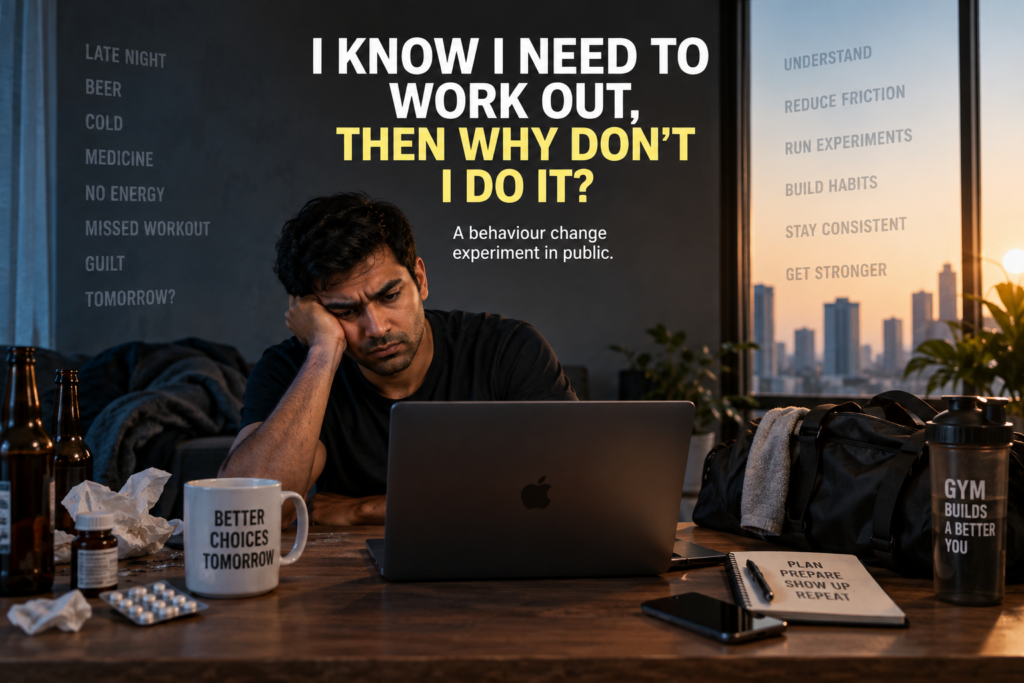
On Sunday, I could have rested. Instead, I went out and had beer. That disrupted my recovery. Chilled beer gave me a cold. I took cold medicine. The medicine made me drowsy.
This morning, I was practically drooling from the drowsiness.
But what bothered me wasn’t really the cold.
It was this:
I wasn’t working out.
My basic commitment for the 6 Pack Project is three workouts every week. Nothing extraordinary. I don’t need to train every day. I don’t need a perfect diet.
Three workouts.
And suddenly, after losing a couple of days, I was worried about whether I would complete even those three.
Which brought me back to a question that has fascinated me for a long time:
I Know I Need to Work Out, Then Why Don’t I Do It?
Almost everyone knows exercise is good for them.
We know we should move.
We know we should eat better.
We know we should sleep properly.
Knowing isn’t particularly difficult.
Doing is.
And perhaps that’s the more interesting problem.
In BKC Traffic
While driving to the office today, I got stuck in traffic just before entering BKC.
And I started thinking about the 6 Pack Project.
Until now, it has largely been a personal experiment.
I work out.
I fail.
I change something.
I try again.
I observe what happens.
I write about it.
But what if I could expand this experiment?
Initially, I thought about calling small business owners and asking them to let me conduct free workshops for their employees.
I still like that idea.
But there is an even simpler way to begin.
Open my laptop and go live.
No permission required.
No venue.
No elaborate presentation.
No need to convince a business owner before I have even conducted my first session.
Just start.
The Thursday Experiment
So I am thinking of starting a weekly live session around one question:
I Know I Need to Work Out, Then Why Don’t I Do It?
Every Thursday evening.
The 6 Pack Project already has a philosophy:
The Path to Power Passes Through the Gym.
But I don’t want the live session to become another motivational fitness lecture.
There is enough fitness advice on the internet.
I am interested in something else.
What happens between knowing and doing?
Why do I genuinely want to exercise in the morning and still not exercise?
Why does putting gym clothes in the wrong place matter?
Why does a bad night’s sleep destroy a morning workout?
Why can discovering a gym at the office suddenly change workout frequency?
Why can one evening of alcohol trigger two or three days of disruption?
Why does exercising three times a week sometimes feel easy and sometimes almost impossible?
These are behaviour questions.
And I want to experiment with them.
Behaviour Change in Public
I don’t want to position myself as someone who has solved fitness.
I haven’t.
In fact, my current slump is evidence of that.
That makes the experiment more interesting to me.
I am the first participant.
Every week, I can bring one real problem from my own life.
Maybe I missed a workout.
Why?
Maybe I completed four workouts.
Why?
Maybe evening workouts suddenly worked better than mornings.
Why?
Maybe alcohol destroyed my recovery.
What exactly happened after that?
Maybe keeping gym clothes at the office removed enough resistance to make a workout happen.
Instead of judging these events as success or failure, I can examine them as data.
What helped the behaviour?
What created resistance?
What can I change before the next attempt?
That is essentially what I have been trying to do with my Behaviour Architecture experiments.
Now I want to do it publicly.
One Problem. One Experiment. One Action.
I want to keep the format simple.
Each Thursday, I take one behavioural problem.
We examine why it happens.
I share what I am discovering through my own experiments.
People attending can examine their own resistance.
And we finish with something small enough to actually test during the following week.
Not:
“I will completely transform my health.”
Something closer to:
“I will exercise three times before next Thursday.”
Or:
“I will keep my workout clothes ready the previous night.”
Or:
“I will walk for ten minutes after lunch every day.”
Then we return the following Thursday.
What happened?
Did it work?
If not, why?
Change something.
Run another experiment.
That’s the whole idea.
Start Before Building
My original thought was to build a corporate workshop and then start approaching businesses.
But I realised that creates unnecessary resistance.
I would need to build the workshop.
Find businesses.
Find owners.
Cold call them.
Convince them.
Schedule the seminar.
Reach their office.
And only then would I discover whether my workshop was any good.
Why not reverse the sequence?
Run it first.
Every Thursday.
Substack Live or YouTube Live.
Even if five people attend.
Even if one person attends.
Even if nobody attends the first one.
The first objective isn’t audience size.
The objective is repetition.
After ten Thursday sessions, I would have delivered ten versions of the idea.
I would know which stories connect.
Which explanations don’t work.
What questions people ask.
What resistance appears repeatedly.
What experiments people actually attempt.
The workshop can emerge from the experiment rather than being designed in isolation.
Then Take It to Businesses
The corporate idea doesn’t disappear.
It simply moves one step later.
Once I have something that works, I can start approaching small businesses.
Then I am no longer saying:
“I have an idea for a seminar.”
I can say:
“I run a weekly behaviour-change session called ‘I Know I Need to Work Out, Then Why Don’t I Do It?’ I would like to run a version of it with your team.”
That’s a very different proposition.
Eventually, I can test whether it creates enough value for businesses to pay for it.
Maybe it becomes a workshop.
Maybe a 30-day employee challenge.
Maybe something completely different.
I don’t know yet.
That’s why it is an experiment.
12 Thursdays
I am giving myself a simple starting runway:
12 Thursdays.
One session every Thursday evening.
One behavioural problem.
One experiment.
One action for the following week.
No need to build an empire around it yet.
Just run the experiment 12 times.
Observe.
Document.
Improve.
And continue my own transformation alongside it.
The Slump Produced an Experiment
I still wish I hadn’t had the beer on Sunday.
The last two days would probably have been better.
My recovery would have been better.
I might already have completed another workout.
And I am still concerned about hitting my three workouts this week.
There is no point pretending that the slump was somehow necessary.
But it wasn’t entirely useless either.
Because sitting inside the slump made the problem extremely visible:
I know I need to work out.
I genuinely want to work out.
Then why don’t I do it?
That’s not just my problem.
It might be a fascinating behaviour-change problem to investigate.
So perhaps the next phase of the 6 Pack Project isn’t about finding the answer.
It is about creating a place where I can repeatedly investigate the question.
Every Thursday.
Live.
In public.
One experiment at a time.
6 Pack Project
The Path to Power Passes Through the Gym.