
You can explore my full 6 pack project here.
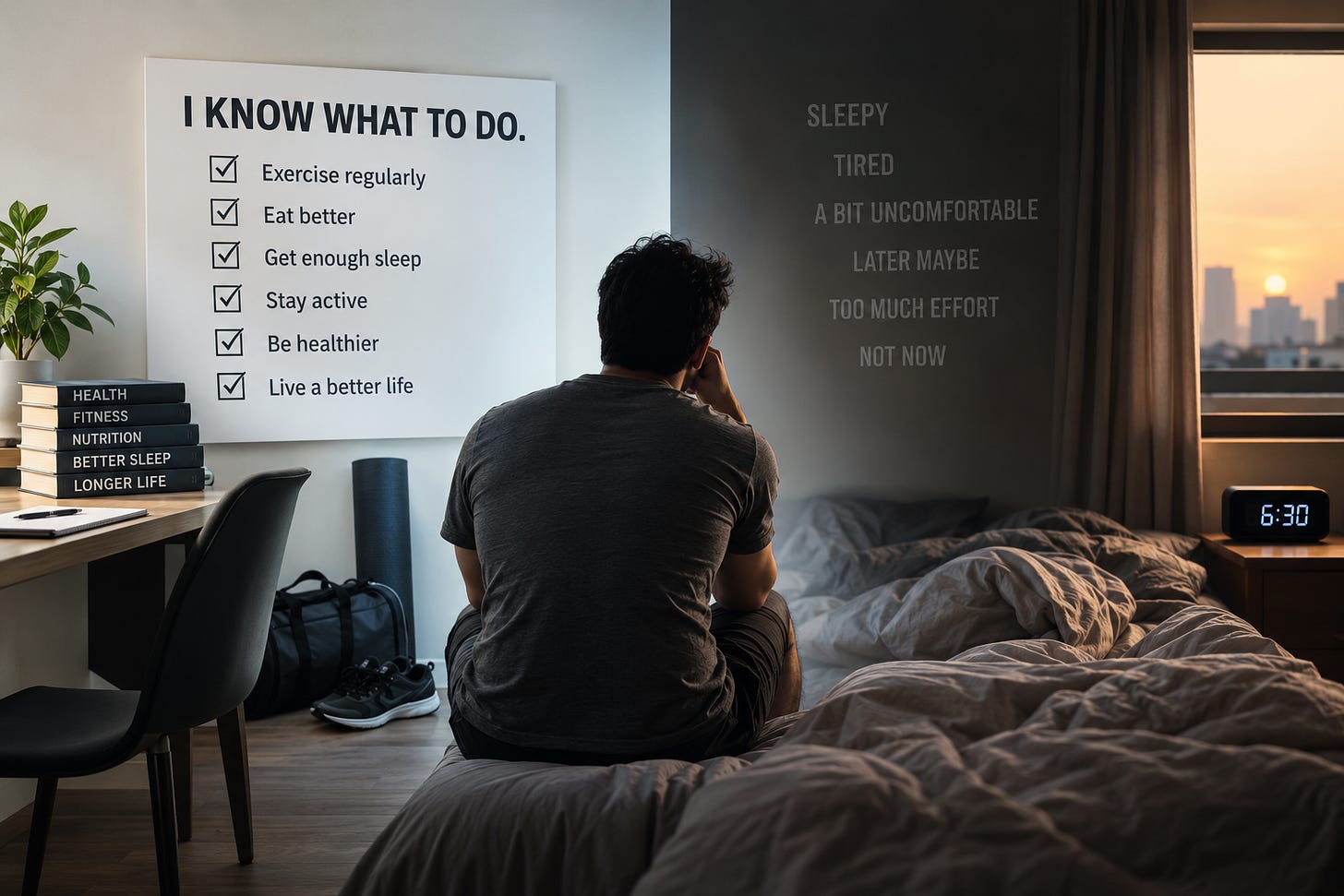
I Know What to Do, So Why Don’t I Do It?
I barely remember the book now. But the question stayed somewhere in my head.
These days, I am becoming obsessed with it.
I sometimes find it more fascinating than the philosophical question, Does God exist?
Because unlike that question, I can experiment with this one.
And my health is turning out to be a wonderful laboratory.
I already knew
For years, I knew that I needed to lose weight.
I knew I needed to exercise. I knew overeating wasn’t helping me. I knew sleep mattered. I knew being physically active was important.
There wasn’t really an information problem.
Yet knowing all of this didn’t stop me from gaining weight and damaging my health.
This contradiction is what interests me.
How can I genuinely want something, know roughly what needs to be done, have the ability to do it—and still repeatedly not do it?
What exactly happens between knowing and doing?
I am beginning to notice resistance
My current experiment is simply to work out three times every week.
Nothing extraordinary.
But trying to make this behaviour consistent has made small things surprisingly visible.
Sometimes I wake up and feel sleepy. Sometimes getting ready feels like an effort. Sometimes office timing interferes. Sometimes I simply don’t feel like moving.
None of these things is a serious obstacle.
That’s exactly what makes them interesting.
A tiny amount of discomfort can sometimes stall the entire action.
I don’t need an injury to miss a workout. I don’t need the gym to close. I don’t need some major crisis.
Sometimes I just need enough internal resistance to say, Not now.
And then nothing happens.
What if the small thing is actually the big thing?
This has created a hypothesis that I want to explore.
Perhaps we underestimate small resistance because we judge it by its size rather than by its repeated effect.
Missing one workout because I feel uncomfortable is irrelevant.
But what if that same discomfort stops 100 workouts?
Suddenly something that looked insignificant has produced an enormous outcome.
The reverse could also be interesting.
What happens if I identify that small resistance and remove it?
I have already seen glimpses in my health experiment.
Changing workout timings helped. Preparing things beforehand helped. Having another opportunity to exercise instead of depending entirely on one particular morning helped. Discovering that my office has a usable gym suddenly created another possibility.
None of these changes are revolutionary.
Most don’t even cost money.
Yet I am curious whether these tiny modifications can produce disproportionately large results simply because they allow the behaviour to happen more often.
Maybe I don’t need more motivation
This is the part I am currently stress-testing.
My instinct whenever I failed was usually to think about discipline.
I need to become more disciplined.
I need more motivation.
I need to force myself.
But lately I have started asking a different question:
What stopped the behaviour this time?
Not philosophically. Literally.
Was I tired?
Was the timing wrong?
Was there an unnecessary step?
Was I hungry?
Did something easier become available?
Was I simply uncomfortable?
Then I can change one thing and see what happens next time.
Sometimes the experiment works. Sometimes it doesn’t. But even failure becomes interesting because it gives me another piece of data.
The strange economics of behaviour
This is perhaps the part that fascinates me most.
We usually associate dramatic outcomes with dramatic interventions.
But behaviour may have strange economics.
A tiny intervention that costs nothing could potentially alter hundreds of future actions.
If moving my gym bag somewhere makes it slightly easier to work out, the value isn’t in moving the bag.
The value is in every workout that follows.
The intervention is tiny. The accumulated consequence may not be.
This is gradually becoming part of what I call my Behaviour Architecture Framework. I don’t know yet how far the idea can be stretched, and I don’t want to pretend that I do.
For now, I have myself, my health, my behaviours and plenty of resistance to experiment with.
And underneath all these experiments sits one question:
Can the gap between knowing and doing be systematically engineered?
I think it is worth finding out.