
Discourse on what you can control and what you cannot control.
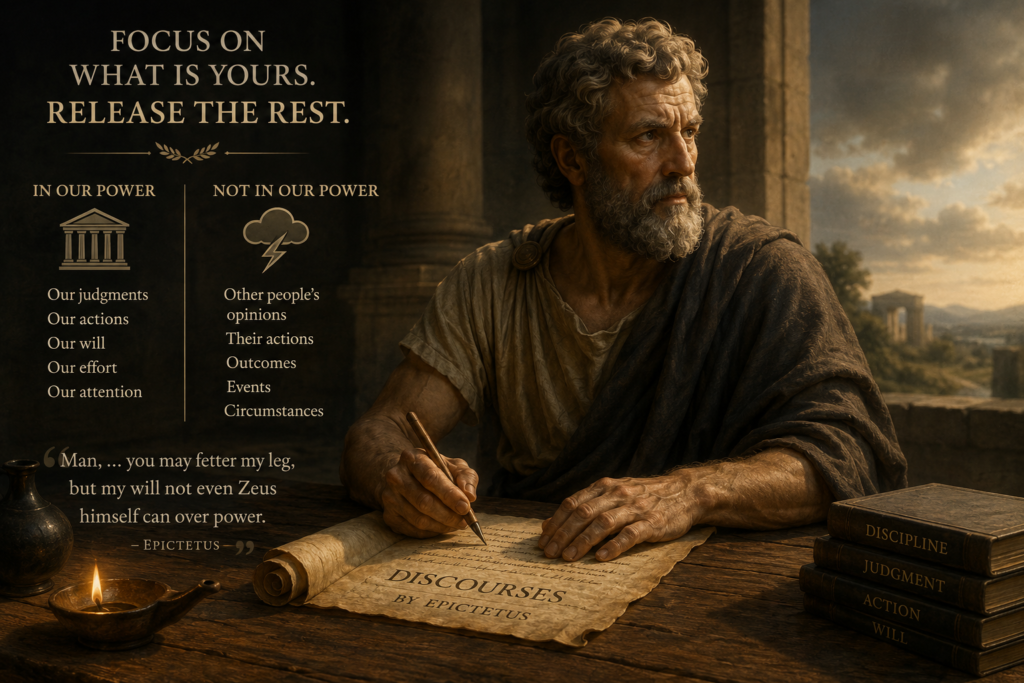
What then should a man have in readiness in such circumstances? … What is mine and what is not mine, and what is permitted to me and what is not permitted to me.
But I will put you in chains … Man, … you may fetter my leg, but my will not even Zeus himself can over power
… He said, ‘I am not hindrance to myself’. – Discourses by Epictetus
Epictetus talks about rationality.
“He says – The rational faculty; for this is the only faculty that we have received which examines itself. “
Epictetus says we have the ability to understand what is in our power and what is not in our power.
So this power must be utilised in order to remove ourselves from the burden. Most of the time, we occupy ourselves with thoughts of things which are not in our control.
The modern workplace provides endless opportunities to fall into this trap.
A senior may speak disrespectfully. A colleague may take credit for your work. Someone may form an opinion about you without understanding the complete situation. A decision affecting you may be taken without consulting you. You may deserve recognition and not receive it. You may work hard and still not get the outcome you expected.
These things can occupy the mind for hours, sometimes days.
We replay conversations. We imagine what we should have said. We become angry about how somebody behaved. We worry about what people think about us. We try to predict decisions that have not yet been made.
But almost none of this gives us additional control over the situation.
The Stoic distinction forces a different question:
What part of this is actually mine?
Someone’s behaviour may not be mine.
Their opinion of me may not be mine.
The final decision may not be mine.
But how I respond is mine.
Whether I communicate clearly is mine.
Whether I do my work properly is mine.
Whether I set a boundary is mine.
Whether I prepare for the next opportunity is mine.
And, perhaps most importantly, where I place my attention is mine.
This does not mean becoming passive. If something needs to be challenged, challenge it. If a conversation needs to happen, have it. If action can improve the situation, take the action.
The distinction is between action and mental occupation.
Do whatever is within your power. Then stop demanding control over what was never yours to control.
That is where Epictetus becomes remarkably practical.
The workplace may control the designation, decision, recognition, reward or consequence.
Other people may control their words and behaviour.
Circumstances may control the outcome.
But they do not automatically get control over the mind.
That part has to be surrendered.
And perhaps this is the practice:
Know what is yours. Act on what is yours. Release what isn’t.