
Also available one – 6 Pack Project
So finally, I am revealing the framework I am using to improve my health.
Suspense music, please.
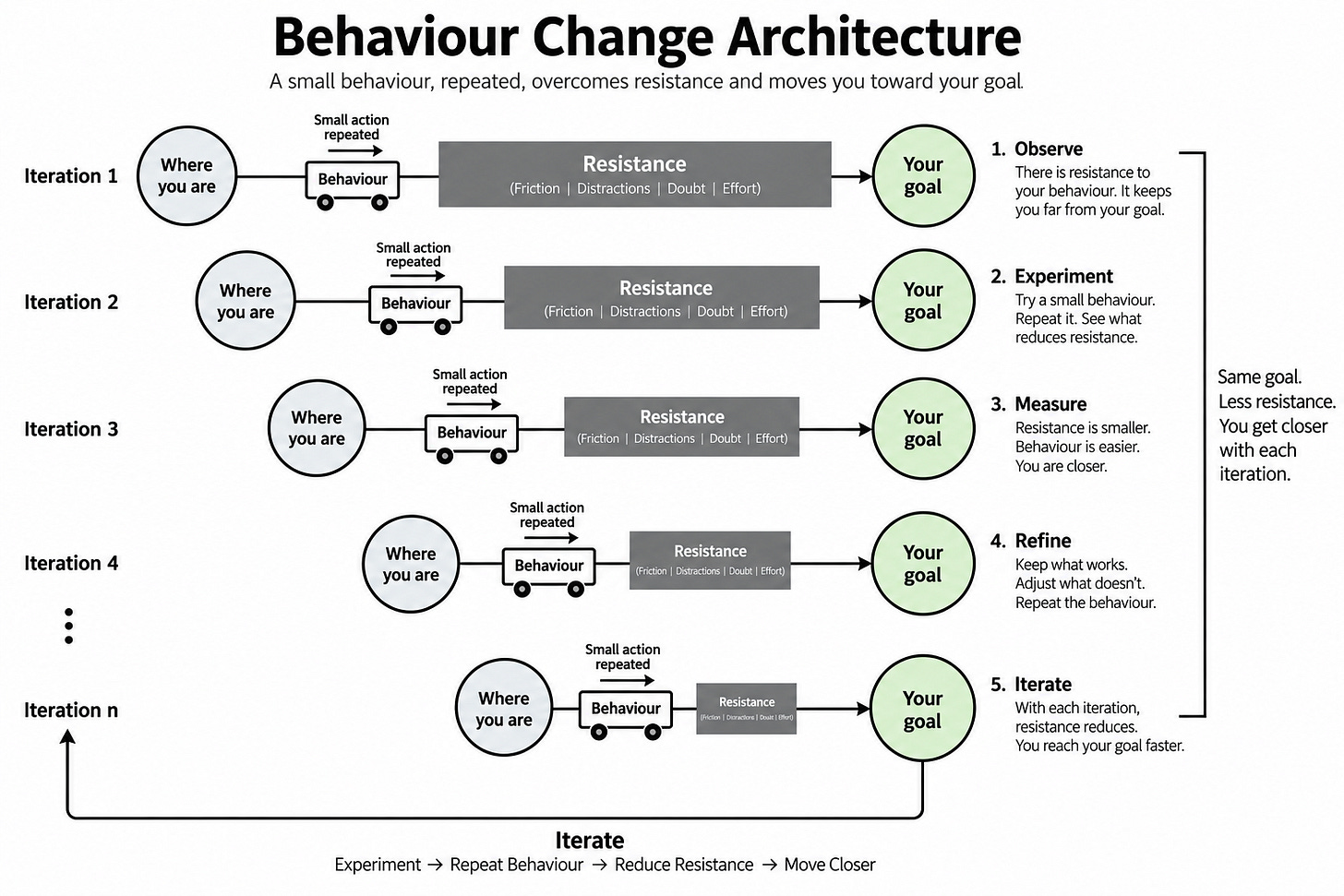
The idea is essentially a combination of the Lean Startup framework applied to Atomic Habits.
I call it the Behaviour Architecture Framework — BAF.
I have always been interested in behavioural psychology, particularly the work of B. F. Skinner. At one point, I was crazy interested in operant conditioning, almost imagining it as some voodoo science for hypnotising people.
Of course, it wasn’t.
But that curiosity slowly evolved into my own philosophy about building behaviour.
This is the framework I am currently stress-testing on myself through the Six Pack Project.
The Basic Idea
This is a simple idea taken seriously.
There is:
Where you are → Where you wish to be
The gap between the two can be imagined as a literal distance.
I want six-pack health. I am currently obese. There is obviously a considerable distance between those two states.
How do I travel that distance?
Through behaviour.
For my Six Pack Project, I have reduced it to two behaviours:
- Workout
- Eat clean
That’s it.
I deliberately don’t want to complicate this.
Redefine Success
Traditionally, success means achieving the final outcome.
If my goal is six-pack abs, I am successful when I see them in the mirror.
BAF defines success differently.
Success is establishing the behaviour capable of producing the desired outcome.
If working out and eating clean become normal, repetitive parts of my life, I consider the behavioural part of the project successful.
This distinction matters.
Otherwise, I could spend months looking in the mirror and considering myself a failure because the final result hasn’t appeared yet.
Instead, I can work on something much closer to my control:
Did I establish the behaviour?
My current experiment gives me 180 days to do exactly that.
Resistance
If establishing behaviour were easy, everyone who wanted six-pack abs would have them.
Something sits between intention and action.
I call it resistance.
In this experiment, I am particularly interested in the internal resistance I can actually modify.
I have access to a gym. I can afford a trainer. I can consult a dietician. I have shoes, clothes and equipment.
Adding more resources isn’t necessarily going to make me work out.
So instead of repeatedly asking, “What else do I need?”, I am asking:
“What is making the behaviour difficult to perform?”
That shifts my attention from resources towards resourcefulness.
Action + Small Proof + Manageable Frequency
I began with two rules.
Small Proof
Initially, my goal wasn’t even to complete an impressive workout.
My goal was:
Go to the gym and take a photograph.
The photograph mattered because it created proof.
Instead of telling myself that I was becoming consistent, I could see evidence that I had actually shown up.
Manageable Frequency
I also didn’t set a goal of working out every day for two hours.
My target was:
Three workouts a week. Every week. 34 minutes maximum.
Nothing heroic.
I wanted a frequency I could repeat.
Measure
Then comes measurement.
Did I perform the behaviour?
Yes or No.
If yes, great. Generate another piece of proof.
If no, something much more interesting happens. Ask.
Ask
The question is:
“What made taking action difficult?”
This requires being unusually truthful because the real answer can sound embarrassingly stupid.
For example, one reason I wasn’t going to the gym was:
I was too comfortable in my chair.
Seriously.
So I examine four things:
- What am I doing?
Sitting in my chair. - Why am I doing it?
Because I love sitting there with my laptop and coffee, brainstorming about my problems. I particularly enjoy thinking about how I should go to the gym instead of actually going to the gym. - How do I feel?
Comfortable. Relaxed. Almost like a thought leader. Perhaps today’s coffee-fuelled brainstorming session will finally produce the breakthrough that solves my health problem. - What sensation am I experiencing?
My thigh muscles are relaxed in the chair.
What a feeling.
Awesome.
And there it is.
My problem wasn’t a lack of information about exercise.
I didn’t want to leave the chair.
Alter
Now I try to alter this system by the smallest possible margin.
Not some extraordinary transformation.
Just a tweak.
Suppose I imagine myself getting up and going to the gym.
What resistance appears?
My comfortable muscles now have to move. I have to get dressed. Find socks. Pack my gym bag. Wear shoes. Walk out.
Fine.
How many of those actions can I remove?
Sleep in gym clothes.
Keep the socks ready.
Pack the gym bag beforehand.
Keep the shoes next to me.
Remove decisions from the moment when resistance is highest.
There is also another part I cannot eliminate: discomfort.
Getting out of a comfortable chair or bed and moving early in the morning doesn’t immediately feel wonderful.
Perhaps the solution isn’t eliminating every uncomfortable sensation.
Perhaps it is learning that this sensation is simply part of the behaviour.
Iterate
This is where the Lean Startup influence enters the framework.
I don’t expect one intervention to magically solve the problem.
I experiment.
Iteration 1: Visualise getting up and notice the discomfort.
Iteration 2: Get up and walk towards the door.
Iteration 3: Put on socks and shoes and walk towards the door.
Iteration 4: Reduce another piece of resistance.
…
Iteration n: Go to the gym.
All iterations need not happen on the same day. You can do it over several days. I took 2 month.
Each experiment asks the same question:
Did this make the behaviour easier to perform?
If not, alter something else and test again.
I am effectively trying to engineer resistance out of the behaviour one small piece at a time.
Take Action. Generate Proof.
Eventually:
Go to the gym. Take the photograph.
Now I have proof.
Not motivation.
Not intention.
Not a plan.
Proof.
Record It
I chose to record my Six Pack Project publicly on Substack.
I used Substack precisely because almost nobody there knew me. Posting directly on my normal social media would have made me more conscious of being judged.
But public posting is essential to BAF.
A journal can work.
Photos can work.
Private videos can work.
The important thing is creating a historical record of the behaviour.
I want to be able to look backwards and see evidence:
I did this. Again. And again. And again.
Consistency Before Intensity
Quality emerges from quantity.
Intensity emerges from consistency.
So intensity isn’t my initial problem.
I don’t need to lift extraordinary weights.
I don’t need a perfect workout.
I don’t need to prove anything to anyone.
First, I need enough evidence to prove something to myself:
I am a person who works out three times a week.
Then I can improve the quality.
The Behaviour Architecture Loop
So BAF, in its simplest form, looks like this:
Define the goal
→ Identify the behaviour
→ Set a manageable frequency
→ Take action
→ Generate proof
→ Measure
→ If action fails, ask why
→ Identify resistance
→ Alter something small
→ Test again
→ Repeat
Every iteration should reduce some resistance.
As resistance falls, action should become easier.
As actions accumulate, proof accumulates.
As proof accumulates, identity will begin to change.
Eventually:
“I am trying to work out”
becomes
“I work out.”
That is the transition I am interested in.
The six-pack is the destination.
Behaviour is the vehicle.
And Behaviour Architecture is my experiment in making that vehicle easier to drive.
I don’t yet know whether the framework works universally. You try.
I have 180 days to find out whether it works on me.