When information isn’t the problem. Execution is.
I am struggling with my health.
More accurately, I am struggling to make healthy changes in my life.
This is not an information problem.
I know what to do.
I know exercise is needed.
I know that smoking and drinking is damaging.
I know that clean diet matters.
I know that sleep matters.
I know that I cannot continue neglecting my body and expect the consequences to remain manageable.
The problem is not knowledge.
The problem is execution.
For a long time, I knew exactly what I should be doing and still did not do it.
The result was predictable: my health dived to the rock bottom.
In March 2026, I was hospitalised with a lung infection.
It was the third time in last two years. But this time was different.
The severity of the illness frightened me. For a brief period in the hospital, I genuinely felt that I could die. And when you are lying in a hospital bed feeling that way, your priorities become remarkably clear.
Suddenly, there is no negotiation.
You are ready to give up anything.
You are ready to change anything.
You are ready to make any commitment necessary to feel normal again.
The irony is that I had known most of those things before I entered the hospital.
The hospital did not give me new information.
It gave me clarity.
For a moment, the consequences became so immediate that every competing desire became insignificant.
Then I was discharged.
I got transferred.
My working hours changed.
My work changed.
My environment changed.
And slowly, the urgency disappeared.
I could produce a long list of reasons why workout was difficult.
None of them really mattered.
Because beneath all the explanations was one simple fact:
I was not doing the thing that mattered.
The battle with Comfort!
I need to work out. – I tell myself:
I then construct a plan.
I will work out early every morning.
It sounds sensible.
Then morning arrives and I ask, what would make me happier?
Working out?
Or sitting down?
Of course sitting down.
So I sit.
And I have been sitting for months.
This is what makes behaviour change so difficult.
The mind is perfectly capable of understanding the long-term consequence while simultaneously choosing the short-term reward.
There is no mystery here.
I don’t need another book explaining that exercise is good.
That is where Arnold Schwarzenegger enters the story.
Arnold as a case study in clarity
I watched the documentary about Arnold Schwarzenegger on Netflix and read his autobiography, Total Recall.
The man is extraordinary.
But what struck me was not simply his physique, his discipline, his success in Hollywood, or his political career.
What struck me was how different his internal operating system appears to be from mine at this stage.
I am struggling with direction.
Arnold appeared to have direction remarkably early.
His story gives me something I currently need:
a demonstration of what clarity can do to a human being’s path.
Arnold’s story begins, in part, with a role model
He saw Reg Park.
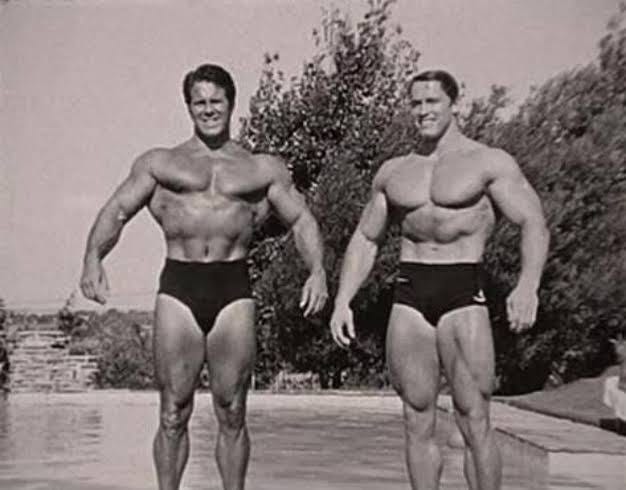
Park was a bodybuilder who had also moved into acting. For Arnold, this was more than an impressive photograph in a magazine.
It was a possible future.
He could see himself in that image.
And once he saw it, something happened.
The future became concrete.
He did not merely want to be successful.
He had an image of what success looked like.
He wanted to become a bodybuilder.
He wanted to win.
He wanted to build an extraordinary physique.
He wanted to go to America.
He wanted to become an actor.
He wanted to stand at the centre of the stage.
The important thing is not whether every detail of his original vision remained unchanged.
The important thing is that he had a direction.
And direction changes everything.
1. Clarity breeds a path
This is the first lesson I take from Arnold.
Clarity breeds a path.
When the destination is vague, almost every road appears reasonable.
When the destination becomes clear, many roads disappear.
This is incredibly important.
What does healthier mean?
Lose weight?
Build muscle?
Improve cardiovascular fitness?
Stop smoking?
Sleep better?
Eat better?
Reduce stress?
All of them?
Because the destination is vague, everything competes with everything else.
But suppose the objective becomes concrete:
I want to build a body that can sustain the life I want to live.
Now the question changes.
What must I do?
Exercise.
Walk.
Eat appropriately.
Sleep.
Recover.
Stop behaviours that damage the system.
Track progress.
The path begins to emerge.
This is what I mean by clarity.
Clarity is not simply knowing what you want.
Clarity reduces the number of decisions required to move toward what you want.
Arnold’s vision did this for him.
He did not have to wake up every morning and conduct a philosophical debate about whether bodybuilding mattered.
The destination had already been chosen.
His work therefore had direction.
2. Work is not the difficult part once the path is clear
“Work is optional.”
But not, if the outcome matters.
What is optional is which work you choose to do.
This distinction matters.
A person with no clarity can work extremely hard and still move nowhere.
They can read books.
Take courses.
Attend meetings.
Build plans.
Research endlessly.
Start projects.
Change strategies.
They can be busy without becoming effective.
The problem is not laziness.
It is misallocation of effort.
Arnold’s advantage was not that he discovered some secret formula that made hard work easy.
His advantage was that he knew where to put the hard work.
That is a very different proposition.
If I know that I want to become a better marketer, I know what kind of work deserves my attention.
If I know I want to become financially independent, I can identify the activities that contribute to that objective.
If I know I want a healthy body, I know what the basic behaviours must be.
The difficult question is not:
“Can I work hard?”
The difficult question is:
“Am I putting my work behind the outcome I actually want?”
This is an Orchestrator question.
The Orchestrator does not worship effort.
The Orchestrator directs effort.
3. Vision and work must become coherent
This may be the most important lesson.
A person’s vision and daily behaviour have to become coherent.
I cannot say:
“My health is extremely important.”
and then repeatedly construct a lifestyle in which exercise is optional.
I cannot say:
“I want to become physically strong.”
while consistently choosing comfort over physical exertion.
I cannot say:
“I want to live a long and capable life.”
while continuing behaviours that I already know are damaging me.
There is a contradiction.
And contradictions consume energy.
Part of my problem over the last few years has been this gap between what I say I value and what my behaviour demonstrates that I value.
My words say health.
My behaviour say comfort.
My mind says:
“You need to work out.”
My body says:
“Stay in the chair.”
My future says:
“You need to change.”
My present says:
“Not today.”
That is incoherence.
And incoherence cannot continue indefinitely.
Eventually reality sends a bill.
For me, the bill came through hospitalisation.
The hospital was a brutal clarity machine
There is something uncomfortable about this.
The hospitalisation temporarily solved my clarity problem.
When I was seriously ill, I did not need motivation.
I did not need a productivity system.
I did not need a habit tracker.
I did not need an inspirational video.
I wanted one thing:
to be healthy again.
Everything else became secondary.
That tells me something important.
Perhaps I have been trying to solve a clarity problem with motivation.
Motivation fluctuates.
Clarity can organise behaviour.
When the consequence became immediate, my hierarchy of priorities became obvious.
The challenge is to create enough clarity before another crisis forces it upon me.
I cannot keep waiting for my body to become dangerously unwell before I take my health seriously.
That would be a terrible strategy.
Arnold’s difficult circumstances did not disappear
There is another part of Arnold’s story that matters.
His early life was not comfortable.
There were material limitations.
There were no guarantees.
He did not begin with an obvious path to global success.
But something interesting happens when a person’s vision becomes sufficiently large.
The obstacles do not necessarily disappear.
Their relative importance changes.
A difficult living condition remains difficult.
A difficult workout remains difficult.
A long journey remains long.
Failure remains painful.
But the question changes from:
“Why should I endure this?”
to:
“What must I endure to get there?”
That is a profound psychological shift.
The obstacle is no longer the centre of the story.
The destination is.
This is perhaps what I have been missing.
I have been looking too closely at the immediate discomfort.
Arnold’s story reminds me to look at the destination.
The chair and the physique
There is a funny contrast here.
Arnold’s life began with an image of the body he wanted to build.
My current life contains an image of the chair I want to sit in.
That is almost comical.
But it reveals something fundamental about behaviour.
We are constantly moving toward images.
The question is:
Which image is stronger?
The image of immediate comfort?
Or the image of the future self?
When the future is vague, the chair wins.
When the future becomes vivid, the chair becomes a temporary distraction.
That is why clarity matters.
Clarity gives the future weight.
I do not need to become Arnold
This is where I have to be careful.
I am not trying to become Arnold Schwarzenegger.
I am not trying to become a bodybuilder.
I do not need his physique.
I do not need his career.
I do not need his personality.
I do not need to reproduce his life.
I need to extract the operating principle.
See the future clearly. Build the path backward. Then make the daily work coherent with the destination.
That is enough.
My current goal is much simpler.
I want to correct years of neglect.
I want to bring my body back under control.
I want to become physically capable.
I want exercise to become normal rather than exceptional.
I want healthy eating to become ordinary rather than something I repeatedly “start.”
I want smoking to disappear from my life rather than remain a behaviour I periodically fight.
This is not a bodybuilding project.
It is a self-correction project.
From crisis to system
There is another lesson here.
A crisis can create clarity.
But a crisis is a terrible long-term operating system.
I cannot depend on fear of hospitalisation to make me exercise.
I cannot depend on guilt to make me eat properly.
I cannot depend on shame to stop me from smoking.
Those emotions may produce short bursts of action.
They do not create a sustainable system.
The real objective is therefore not:
“How do I remain terrified enough to take care of myself?”
It is:
“How do I make taking care of myself the obvious path?”
That is a much more useful question.
And that is where Project Orchestrator becomes relevant.
The Orchestrator’s job is not to generate endless motivation.
The job is to create coherence between:
Vision → Priorities → Environment → Behaviour → Outcome.
When these are aligned, behaviour requires less internal negotiation.
When they are misaligned, every action becomes a battle.
Arnold and the Orchestrator
This is why Arnold belongs in Project Orchestrator.
Not because he is a perfect human being.
Not because every part of his life should be copied.
Not because bodybuilding is the answer.
He belongs because his life demonstrates the power of a sufficiently clear destination.
He saw something.
He wanted it.
He committed to it.
Then he organised enormous amounts of effort around it.
That is path building.
And perhaps this is the lesson I need at this stage of my own life.
I have spent enough time knowing.
I now need to build.
I know that health matters.
Now I need to build the health system.
I know that exercise matters.
Now I need to make exercise routine.
I know that smoking is damaging.
Now I need to eliminate it.
I know that food matters.
Now I need to measure what I actually eat rather than relying on what I believe I eat.
I know that comfort can become a trap.
Now I need to stop negotiating with the chair.
Clarity adopted
The title of this experiment is not “Arnold copied.”
It is:
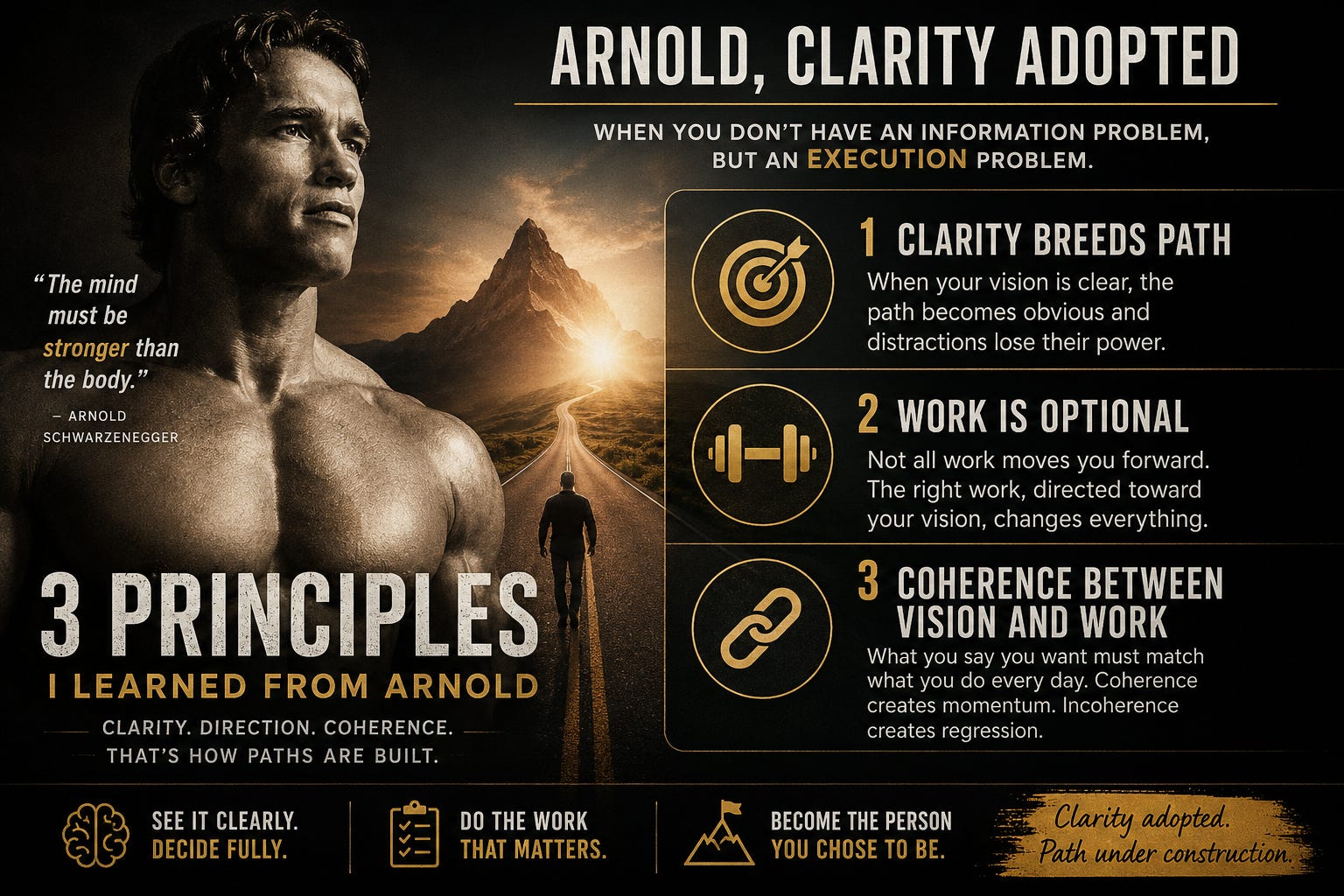
Arnold, Clarity Adopted.
Because I am not adopting Arnold’s body.
I am adopting something more fundamental.
His clarity.
The ability to look at a desired future and allow that future to organise the present.
This changes the question I ask myself.
Instead of:
“Do I feel like working out today?”
I ask:
“What does the man who wants this outcome do today?”
Instead of:
“Can I get away with smoking one cigarette?”
I ask:
“Does this behaviour belong to the future I am building?”
Instead of:
“Wouldn’t it be more comfortable to sit down?”
I ask:
“Which future am I voting for?”
These questions are much harder to negotiate with.
Because they move the discussion away from today’s mood.
They return it to the destination.
The lesson
My four lessons from Arnold are –
1. Clarity breeds a path.
A sufficiently clear destination begins to eliminate irrelevant choices.
2. Effort must be directed.
Hard work is not valuable merely because it is hard. It becomes valuable when it is attached to the right outcome.
3. Vision and work must be coherent.
The life I say I want and the behaviours I repeatedly perform cannot remain in contradiction.
4. Build before crisis forces you to.
A hospitalisation can create clarity.
A better system creates clarity before the hospital.
That is the real lesson I am taking from Arnold.
I ignored my health for too long.
I cannot undo those years.
But I can change the direction of the next years.
I do not need to become Arnold Schwarzenegger.
I need to become sufficiently clear about the man I want to become that the path starts becoming obvious.
And then I need to walk it.
Not perfectly.
Not dramatically.
Not heroically every day.
Just consistently enough that the future I want eventually becomes the life I have.
Clarity adopted.
Path under construction.