
Laxmi Mittal, Indian Steel Magnate who went Global and bought Arcelor
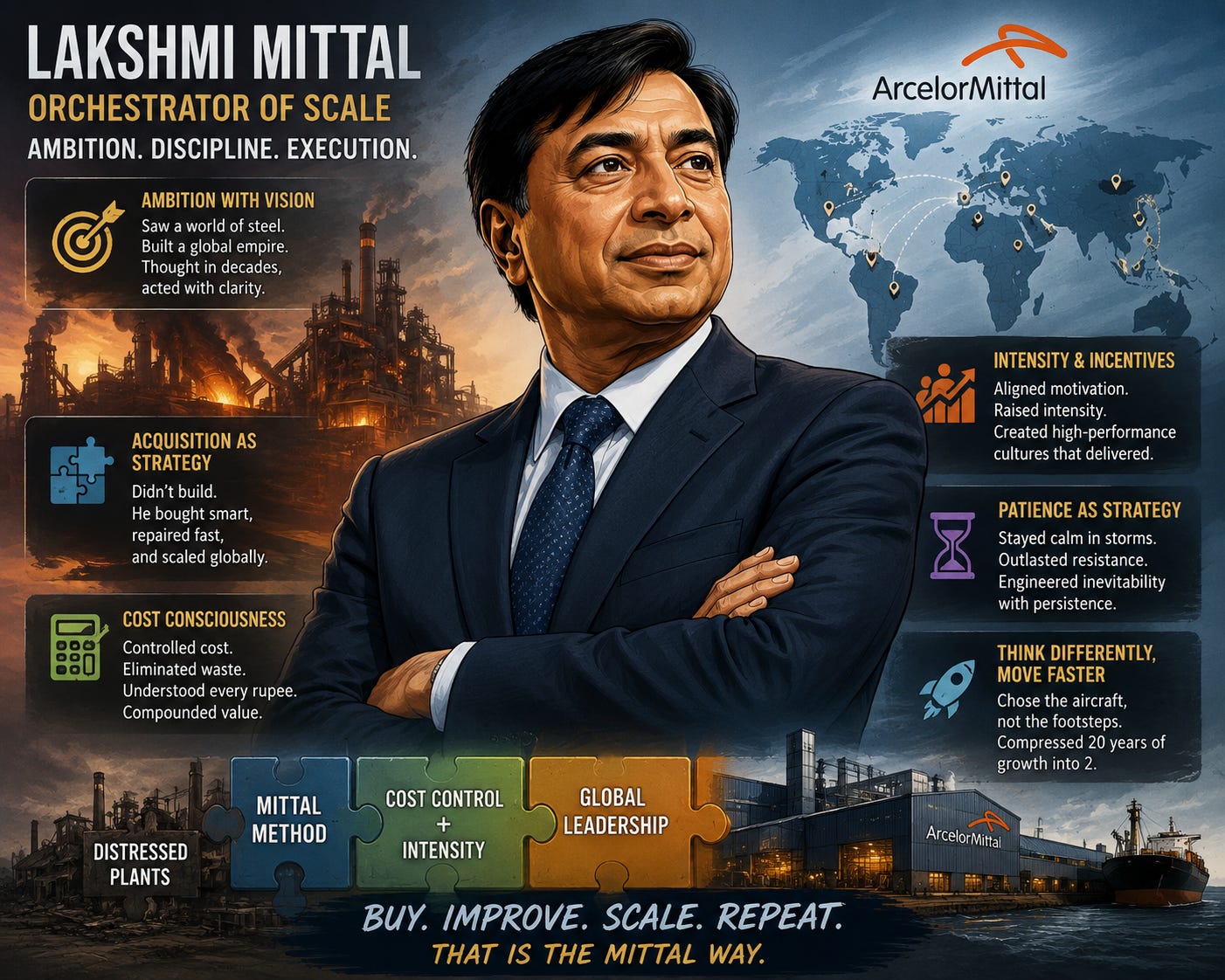
Disclaimer
This article is intended solely for informational, educational, and analytical purposes. It is based on the author’s interpretation of publicly available material, including biographies such as Cold Steel, interviews, speeches, articles, business case studies, and secondary literature related to Lakshmi Mittal and the global steel industry. It should not be treated as a journalistic investigation, definitive biography, investment advice, or verified account of events.
The purpose of this work is to study Lakshmi Mittal through the lens of operational strategy, scale, incentives, acquisitions, cost consciousness, intensity, patience, and strategic thinking. The article is designed as a learning document aimed at extracting patterns, frameworks, and mental models relevant to business, leadership, execution, and institutional growth.
The ideas, frameworks, analogies, and conclusions presented here are interpretative and analytical in nature. They represent the observations and opinions of the author and should not be understood as definitive claims regarding the intentions, motivations, or internal decision-making processes of any individual, organization, or institution mentioned.
References to business leaders such as John D. Rockefeller, Dhirubhai Ambani, Frank Slootman, Lalit Modi, Warren Buffett, and others are included for comparative and educational analysis only. They are not intended as endorsements, equivalencies, or comprehensive evaluations of their careers, ethics, or ideologies.
This article does not aim to glorify wealth, endorse aggressive capitalism, dismiss institutional frameworks, or provide simplistic formulas for success. Instead, it seeks to encourage critical thinking about strategy, leverage, operational discipline, incentives, and unconventional approaches to growth.
Readers are encouraged to approach this work analytically, maintain independent judgment, and refer to primary sources and broader perspectives for factual verification and deeper understanding.
Lakshmi Mittal — The Industrialist Who Bought Arcellor
In 2006, Mittal Steel acquired Arcelor.
I had just completed my 10th.
I still remember the atmosphere around the news. For perhaps the first time in my life, I saw widespread discussion around an Indian taking control of a major foreign company.
This felt psychologically significant.
For decades, we had unconsciously inherited the hangover of colonial thinking — that Indians were secondary players in global business. We associated Western countries with sophistication, capital, and industrial power, while India was viewed as chaotic, poor, and operationally weak.
The Arcelor acquisition disrupted that mental framework.
For the first time, I became consciously aware of the possibility that an Indian businessman could dominate a global industry traditionally controlled by Europe and America. And at the center of that moment stood one man — Lakshmi Mittal.
That was the first time I heard his name.
The second time I encountered Mittal was through the book ‘The Dhandho Investor’ by Mohnish Pabrai.
Pabrai uses Mittal as an example of the “Dhandho” framework — a style of wealth creation built around asymmetric risk-reward opportunities, operational discipline, and intelligent capital allocation.
But despite hearing about Mittal in these two important contexts, I still knew very little about him.
That changed when I began studying him seriously while preparing this case study.
Why Study Lakshmi Mittal?
There are several reasons why Mittal’s story feels deeply relevant to me at this stage of life.
1. Mittal Represents a Repeatable Wealth-Building Mechanism
Over the years, my relationship with money has changed dramatically.
My thinking moved from:
- “Money does not matter”
to - “Money is secondary”
and finally to - “Money matters.”
Not merely for luxury, but because capital represents leverage, freedom, resilience, and strategic power.
Mittal’s life is important because his wealth was not created through hype, technology disruption, or financial engineering alone. It emerged from a highly repeatable mechanism:
- buy distressed assets,
- improve operations,
- reduce inefficiencies,
- increase output,
- consolidate industries,
- repeat at scale.
This makes his success intellectually valuable to study.
2. Mittal Reflects an Indian Approach to Business
As I study entrepreneurs like Dhirubhai Ambani and Mittal, I am beginning to notice what I would call an “Indian approach to business.”
This approach is not built around innovation, elegance or perfection. It is built around:
- frugality,
- survival,
- adaptability,
- negotiation,
- operational flexibility,
- and extracting value from imperfect situations.
Mittal appears to embody this philosophy at an industrial scale.
He did not build glamorous products.
He did not operate in fashionable industries.
He operated in steel — one of the most brutal, cyclical, capital-intensive industries in the world.
And yet he dominated it.
That itself deserves investigation.
3. Operational Efficiency Was His Superpower
Mittal’s core idea was surprisingly simple:
buy struggling steel plants and make them efficient again.
At a time when countries and corporations were eager to exit the steel business, Mittal aggressively entered it.
This is important.
Most people search for opportunity in exciting industries. Mittal searched for neglected assets with operational inefficiencies.
His formula was brutally practical:
- reduce costs,
- improve productivity,
- remove clutter,
- standardize systems,
- optimize output,
- centralize purchasing,
- and drive discipline across operations.
In essence, Mittal treated inefficiency as opportunity.
What is fascinating is that this style of thinking feels culturally familiar to Indians. In a resource-constrained environment like India, optimization is not theory — it is survival.
4. Mittal Scaled Through Acquisitions, Not Through Reinvention
Many industrialists build wealth by expanding production gradually over decades.
Mittal’s approach was different.
His real genius lay in acquisitions and capital allocation.
He scaled by buying existing plants across multiple countries and integrating them into a larger operational system. This allowed him to expand globally far faster than traditional industrial growth models.
In that sense, Mittal was not merely a steel manufacturer.
He was a capital allocator operating through the medium of steel.
And this is perhaps the most intriguing part of his story:
the underlying idea was simple.
Buy undervalued assets.
Improve operations.
Scale through acquisition.
Simple does not mean easy.
Executing this model across countries, governments, unions, cultures, and economic cycles required extraordinary conviction, discipline, and aggression.
That is what makes Lakshmi Mittal worth studying.
Indonesia Changed Everything
As I studied Lakshmi Mittal more deeply, a striking contrast between him and Dhirubhai Ambani began to emerge.
Dhirubhai mastered the Indian system.
Mittal escaped it.
This distinction is important.
Dhirubhai operated during the era of the License Raj and became exceptionally skilled at navigating bureaucracy, regulation, and political complexity within India. He understood that in India, business success required not only operational capability but also mastery over the system itself.
Mittal, however, appeared fundamentally impatient with constraints.
While his family already operated a steel business in India, the company suffered under government-imposed restrictions on production capacity and expansion. Growth was controlled. Productivity was restricted. Ambition had boundaries.
Then came a turning point.
Indonesia — The First Taste of Freedom
Mittal travelled to Indonesia with the intention of selling a property owned by the family. What was initially meant to be a routine business visit became something far more consequential.
Indonesia represented something he had not fully experienced in India:
economic freedom.
There was no suffocating License Raj.
No endless permissions.
No artificial production restrictions.
For a young industrialist with ambition, this environment was intoxicating.
Most people in that situation would have sold the property, enjoyed the trip, and returned home.
Mittal did the opposite.
At the age of just 25, he decided to build his own steel plant in Indonesia.
That decision would alter the course of his life.
The Mini-Mill Strategy — Cost Above Everything
Mittal’s thinking from the beginning was remarkably pragmatic.
Instead of building a massive traditional integrated steel plant with expensive blast furnaces and coking coal infrastructure, he chose to build a mini-mill.
This decision reflected a pattern that would define his entire career:
cost discipline over industrial glamour.
Mini-mills required significantly lower capital expenditure and operated more efficiently. The structure gave him a major cost advantage — reportedly close to 50% compared to traditional production models.
This allowed him to compete aggressively against dominant Japanese steel suppliers who had already established themselves in the Indonesian market.
Mittal was not trying to build the most prestigious steel company.
He was trying to build the cheapest efficient producer.
That distinction matters enormously.
Even then, success did not happen overnight. It took him nearly eleven years to scale production to around 330,000 tonnes annually.
This is another important lesson from Mittal’s story:
simple strategies often require long periods of relentless execution.
Backward Integration — The Dhirubhai Parallel
As the Indonesian operations grew, Mittal encountered another classic industrial problem: dependence on raw material suppliers.
This is where the comparison with Dhirubhai becomes fascinating again.
Like Dhirubhai, Mittal understood the importance of backward integration. Control the supply chain, and you control margins.
Around this time, the state-owned Iron and Steel Company of Trinidad and Tobago was collapsing financially. The plant was reportedly losing nearly $10 million every month.
Most buyers would have avoided such a distressed asset.
Mittal saw opportunity.
But his approach was pure Dhandho.
Instead of immediately buying the company outright, he structured a low-risk arrangement with the government. His proposal was essentially:
“You are already losing $10 million every month. Give me operational control, and I will pay you that amount monthly while turning around the plant.”
This was classic asymmetric thinking:
limited downside, enormous upside.
Mittal added another condition:
if he successfully revived the operations, he would receive the option to acquire the company within five years.
The government accepted.
Mittal then executed the same playbook that would later become his global operating system:
- cut costs aggressively,
- improve operational efficiency,
- remove bottlenecks,
- increase production intensity,
- restore profitability.
The turnaround succeeded.
And eventually, in 1993, Mittal acquired the company.
Mexico — Repeating the Formula
In 1992, Mittal acquired a steel plant in Mexico.
What becomes fascinating at this stage is the repeatability of his model.
Different country.
Different workforce.
Different politics.
Same operating philosophy.
Mittal was building something far more important than a steel company.
He was building a repeatable turnaround machine.
The Mittal Operating System
Across acquisitions, Mittal’s approach remained surprisingly consistent.
1. Take Operational Control
Mittal believed weak management destroys industrial assets faster than bad economics.
One of his first moves after acquisitions was to install trusted high-performing managers — many of them Indian operators known for discipline, adaptability, and execution intensity.
2. Identify Bottlenecks Ruthlessly
Mittal approached steel plants almost like an engineer diagnosing inefficiencies.
He searched for:
- production delays,
- excess manpower,
- outdated systems,
- procurement inefficiencies,
- logistical friction,
- and underutilized capacity.
Then he attacked these bottlenecks aggressively.
3. Cost Was Everything
For Mittal, cost reduction was not a side activity.
It was strategy itself.
In commodity businesses like steel, differentiation is limited. The low-cost producer survives downturns and dominates cycles.
Mittal understood this deeply.
4. Aggressive Targets Create Momentum
One recurring characteristic across Mittal’s businesses was intensity.
He pushed for ambitious production goals and demanded speed in execution.
There is an important psychological insight here:
many organizations decline not because they lack resources, but because they lose intensity.
Mittal brought intensity back into failing systems.
5. Profitability Was the Final Metric
Mittal was not emotionally attached to ideology, prestige, or industrial symbolism.
The objective was straightforward:
increase profitability.
Everything else was secondary.
And this simplicity is precisely what makes his story powerful.
On the surface, the strategy appears obvious.
In reality, very few people possess the conviction to buy failing industrial assets across multiple countries and impose operational discipline at scale.
That is where Lakshmi Mittal separated himself from everyone else.
‘No, we must grow’
‘Mittal has the kind of hunger that you Europeans will never understand,’ they told him – From Cold Steel
One of the striking similarities between Dhirubhai Ambani and Lakshmi Mittal is not merely ambition, but the refusal to remain small. Both men carried within them a near-imperial expansion. They were not content with survival, stability, or even moderate success. Growth itself became a philosophy. Remaining stagnant almost appeared unnatural to them.
After Kazakhstan, Malay Mukherjee once asked Mittal:
“LN, shouldn’t we pause for a year and take stock?”
The answer came instantly:
“No, we must grow, we must move on.”
That sentence reveals the psychology of Mittal. Growth was not an event. It was momentum. It was identity.
We defined Dhirubhai by the word “Scale.” The same pattern appears again with Mittal. Whether it was Indonesia, Trinidad, Mexico, Kazakhstan, or Romania, the pattern remained constant — acquire, improve, expand, repeat. But the important distinction is this: neither Dhirubhai nor Mittal pursued reckless growth. Their expansion was disciplined expansion. They understood a principle that destroys many ambitious men:
Growth without cost control eventually becomes self-destruction.
Both men treated cost not as a boring accounting function, but as a strategic weapon. Cost discipline financed ambition. The lower the cost structure, the faster the ability to expand. This is where Mittal separates himself from ordinary businessmen.
He did not merely buy struggling steel plants. He bought inefficiency and converted it into productivity.
This philosophy strongly resembles the methods of John D. Rockefeller. Rockefeller understood that domination does not come only from revenue growth; it comes from controlling costs better than competitors. Standard Oil relentlessly reduced waste at every stage — transportation, refining, packaging, storage, and distribution. Even small savings mattered. It is famously said that Rockefeller studied how to save fractions of a cent on oil barrels because multiplied over millions of units, tiny efficiencies became enormous profit advantages.
Mittal operated with a similar mentality. When he acquired failing plants, he did not begin with grand speeches about innovation. He began with numbers. Energy consumption. Labour productivity. Procurement inefficiencies. Downtime. Output per worker. Capacity utilization. Cost per ton. Steel is a brutal industry. Margins can collapse quickly. Survival depends on operational discipline.
This is the hidden side of ambition most people ignore. Ambition sounds glamorous from the outside, but large-scale growth requires almost obsessive control underneath. The discipline to measure, monitor, and optimize.
For modern professionals and entrepreneurs, this principle remains deeply actionable.
First, growth should never hide inefficiency. Many businesses expand revenue while bleeding internally through poor systems, unnecessary hiring, weak execution, and operational chaos. Bigger revenue with weak discipline simply creates a bigger fragile structure.
Second, cost control is not about being cheap. Rockefeller was not cheap. Mittal was not cheap. They invested aggressively where productivity increased. Their philosophy was different: Cut waste mercilessly. Invest aggressively where returns compound.
Third, scale requires systems. Dhirubhai built distribution systems. Rockefeller built logistical systems. Mittal built operational systems. None relied purely on inspiration. They relied on repeatable structures that reduced friction.
But cost alone cannot create an empire. Cost creates survival. Productivity creates dominance.
This is where intensity and incentives enter the picture.
Mittal understood that factories are not transformed by machinery alone. They are transformed by human energy. A plant filled with passive employees becomes inefficient regardless of technology. Therefore, Mittal’s approach consistently focused on performance intensity.
This idea closely connects with the philosophy described in Amp It Up by Frank Slootman. Slootman repeatedly emphasizes that extraordinary organizations operate at a different intensity level. Urgency is cultural. High-performance environments are not built through comfort; they are built through accountability, speed, and relentless execution.
Mittal’s operations reflected this mindset long before it became fashionable management language.
When Mittal acquired failing plants, productivity often surged dramatically within a few years. This was not magic. The assets already existed. The change came from expectations and incentives. Plants previously operating under bureaucratic lethargy were suddenly pushed toward measurable performance.
The difference between average organizations and elite organizations is often energy density.
In low-intensity cultures:
- Meetings replace execution.
- Accountability becomes diluted.
- Mediocrity becomes normalized.
- Speed disappears.
In high-intensity cultures:
- Targets are visible.
- Performance is measured.
- Execution speed matters.
- Ownership increases.
Mittal repeatedly created environments where managers knew output mattered. Results mattered. Efficiency mattered.
This also connects directly with incentive systems.
Human beings respond to incentives more than slogans. Dhirubhai understood this in distribution. Rockefeller understood this in operations. Mittal understood this in productivity.
If incentives reward politics, politics grows.
If incentives reward activity without outcomes, bureaucracy grows.
If incentives reward performance, execution grows.
One of the most overlooked realities in business is that culture is not built through motivational speeches. Culture is built through what gets rewarded and what gets punished.
Mittal’s system rewarded operational performance. Managers who improved output, reduced waste, and increased profitability became valuable. This naturally created intensity across the organization.
The lesson here becomes powerful for anyone building a business, career, or institution.
Ambition alone is insufficient.
Motivation alone is insufficient.
Vision alone is insufficient.
Sustainable growth requires three forces working together:
- Ambition — the desire to expand beyond comfort.
- Cost discipline — the control system that prevents collapse.
- Intensity and incentives — the energy system that drives productivity.
Remove one, and the structure weakens.
Ambition without cost discipline becomes chaos.
Cost discipline without ambition becomes stagnation.
Intensity without incentives becomes burnout.
Mittal combined all three.
That is why his growth was not accidental expansion. It was engineered expansion.
And perhaps this is the deeper pattern connecting Dhirubhai, Rockefeller, and Mittal. None of them merely wanted wealth. They wanted scale. They wanted dominance through systems. They understood that empires are not built only by dreaming bigger than others, but by operating harder, faster, and more efficiently than others for decades.
Their greatness was not simply in thinking big.
It was in sustaining bigness through discipline.
Patience as Strategy
“There was an inevitability about the Mittals’ persistence, patience and pragmatism.” – From Cold Steel
That single line from Cold Steel captures something deeper than mere persistence. It reveals a strategic temperament. While most people study Lakshmi Mittal through the lens of ambition, acquisitions, or scale, one of his greatest strengths was psychological endurance. He could absorb pressure for long periods without losing direction.
This becomes especially visible during the battle for ArcelorMittal.
The takeover was not simply a financial transaction. It became a geopolitical and psychological war. Mittal faced resistance from governments, media, unions, competitors, and nationalist sentiment across Europe. Politicians openly opposed him. The bid was portrayed as hostile. Elites attempted to isolate him socially and politically. Many businessmen under such pressure would either become emotional or retreat tactically.
Mittal did neither.
He waited.
He adjusted.
He persisted.
He allowed resistance to exhaust itself.
This is where patience becomes strategy rather than passive waiting.
Most people misunderstand patience. They associate it with slowness, hesitation, or inactivity. But in reality, elite operators combine two contradictory qualities simultaneously:
Speed in execution.
Patience in outcomes.
This contradiction appears repeatedly among powerful business and political figures.
Mittal moved rapidly in identifying acquisitions, restructuring plants, and negotiating deals. But when confronted with long resistance, he did not panic. He understood that large outcomes require time for conditions to mature.
This resembles the political style of Sharad Pawar. Pawar’s career repeatedly demonstrates the ability to engineer inevitability rather than forcing immediate victory.
Pawar often survives political storms not because he wins instantly, but because he stays relevant longer than others remain stable. He allows alliances, rivalries, egos, and circumstances to evolve naturally until the balance tilts toward him. His approach is rarely emotional or theatrical. It is positional. He preserves optionality. He waits for timing to create leverage.
That is orchestration.
And this is exactly what Mittal demonstrated during the Arcelor episode. Instead of reacting emotionally to every attack, he maintained strategic composure. He understood something many ambitious individuals fail to grasp:
Time itself can become a weapon.
The impatient man exhausts himself.
The patient strategist exhausts opponents.
This principle appears repeatedly in business history.
Warren Buffett built enormous wealth not merely through intelligence, but through extraordinary patience. Buffett repeatedly emphasizes that markets reward long-term discipline more than constant activity. He famously stated that the stock market transfers money from the impatient to the patient.
But Buffett’s patience is not inactivity. Berkshire Hathaway moves decisively when opportunity appears. The waiting happens before the strike.
Similarly, Jeff Bezos demonstrated patience as strategic positioning. For years, Amazon operated with thin profits while continuously building infrastructure, logistics, and customer loyalty. Many critics misunderstood this as weakness. Bezos was willing to absorb short-term criticism because he optimized for long-term inevitability.
Again the same pattern emerges:
Short-term speed.
Long-term patience.
Even John D. Rockefeller displayed this characteristic. Rockefeller rarely engaged in dramatic confrontation. He quietly expanded infrastructure, improved operational efficiency, and increased leverage over time. Competitors often underestimated him because his aggression appeared calm.
This combination is psychologically difficult because human beings naturally seek immediate emotional relief.
When facing uncertainty, criticism, rejection, or delay, most people feel compelled to react instantly:
- respond emotionally,
- force outcomes,
- abandon strategy,
- seek quick validation,
- or change direction prematurely.
Mittal’s strength was different. He could remain steady while the environment remained unstable.
That requires emotional discipline.
And this is where the relationship between speed and patience becomes important.
At first glance they appear contradictory.
But in elite execution they actually complement each other.
Patience without speed becomes laziness.
Speed without patience becomes recklessness.
Mittal combined both.
Inside operations he moved aggressively:
- restructuring failing steel plants,
- reducing costs,
- improving productivity,
- executing acquisitions quickly.
But regarding larger outcomes — reputation, negotiations, market positioning, geopolitical acceptance — he allowed time to work in his favor.
This distinction is critical.
Modern culture glorifies immediate action but rarely teaches strategic waiting. Yet many breakthroughs in life require incubation periods:
- trust,
- reputation,
- influence,
- negotiations,
- political positioning,
- organizational culture,
- wealth compounding,
- relationships,
- and mastery.
These cannot be forced instantly.
The individual obsessed with immediate results often destroys long-term positioning.
This is visible even in careers. Many professionals switch paths repeatedly because results do not appear within months. They confuse delayed outcomes with failure. Meanwhile, the patient operator compounds quietly beneath visibility.
Mittal’s journey demonstrates that patience is not passive tolerance. It is controlled endurance directed toward a clear objective.
Patience becomes powerful only when connected with conviction.
Without conviction, waiting becomes drifting.
Without direction, patience becomes stagnation.
Mittal knew exactly what he wanted.
This clarity allowed him to withstand pressure during the Arcelor battle. Others focused on daily headlines. Mittal focused on eventual control.
That is why the phrase “engineering inevitability” becomes important.
The highest-level operators do not merely chase opportunities. They shape conditions until the outcome becomes increasingly probable.
This requires:
- strategic positioning,
- emotional control,
- timing,
- persistence,
- and long-term thinking.
The impatient individual tries to win every moment.
The strategic individual optimizes for the final position.
There is another important lesson hidden here:
Patience increases negotiating power.
The desperate side almost always loses leverage.
The calmer side usually controls the frame.
Mittal repeatedly demonstrated the ability to absorb delay without appearing weak. This psychological steadiness changes negotiations dramatically. Opponents begin making emotional decisions while the patient strategist preserves clarity.
This principle applies far beyond billion-dollar acquisitions.
In sales:
The patient negotiator often closes stronger deals.
In leadership:
The patient leader avoids unnecessary conflict escalation.
In investing:
The patient investor benefits from compounding.
In personal growth:
The patient individual survives the uncomfortable middle phase where most people quit.
This becomes actionable only when converted into practice.
Actionable Practices to Develop Patience as Strategy
1. Separate execution speed from outcome timing
Move fast on controllable actions.
Remain calm about external results.
You can control:
- effort,
- systems,
- preparation,
- consistency,
- communication.
You cannot fully control:
- market timing,
- public perception,
- other people’s decisions,
- long-term outcomes.
Mittal controlled execution relentlessly while allowing outcomes to mature.
2. Build “pressure tolerance”
Most impatience comes from emotional discomfort.
Practice remaining composed during:
- delayed responses,
- uncertainty,
- criticism,
- slow progress,
- negotiation silence.
Do not immediately react just to reduce anxiety.
3. Think in multi-year positioning
Most people optimize for weeks.
Strategic operators optimize for years.
Ask:
“What position am I building over 5 years?”
This immediately changes decision quality.
4. Avoid emotional oscillation
Impatient individuals constantly alternate between overexcitement and discouragement.
Patience requires emotional steadiness.
Not emotional numbness — steadiness.
Mittal did not abandon direction because public opinion fluctuated.
5. Preserve optionality
Sharad Pawar’s political survival repeatedly reflects this principle.
Never corner yourself unnecessarily.
Maintain relationships.
Maintain credibility.
Maintain resources.
Maintain flexibility.
Patience becomes easier when you are not desperate.
6. Learn strategic silence
Not every attack deserves response.
Not every opportunity deserves pursuit.
Not every disagreement requires confrontation.
Often silence increases leverage more than reaction.
Ultimately, patience as strategy is about resisting the emotional urge to force reality prematurely.
Mittal teaches an important lesson here:
History often rewards not merely the fastest man, but the man who can endure the longest while continuing to execute intelligently.
That is why persistence alone is insufficient.
Persistence without patience becomes frantic.
Patience without action becomes inertia.
But when ambition, disciplined execution, and strategic patience combine, inevitability begins to emerge.
Buy, Don’t Build — The Orchestrator’s Shortcut to Scale
“In just twenty years Mittal had amassed a $27.7 billion fortune.”
That single line from Cold Steel captures the astonishing velocity of Lakshmi Mittal’s rise. Steel is not software. It is one of the slowest and most capital-intensive industries on earth. Building a steel empire traditionally requires decades of construction, regulatory approvals, financing, infrastructure development, labour integration, supply chains, and operational stabilization.
A steel plant is not built in months.
It is built across years.
Yet Mittal compressed what should have taken generations into merely two decades.
How?
The answer reveals one of the most important strategic principles behind modern wealth creation:
He stopped thinking like a builder.
He started thinking like an orchestrator.
After the success of his Indonesian steel plant, Mittal realized something fundamental. If he followed the traditional industrial route — building new plants from scratch — his ambition would outrun his lifespan. Time itself would become the bottleneck.
And this is where his thinking changed.
Instead of building steel plants one by one, he began acquiring already-built, operational, often struggling steel plants across the world. Mexico. Trinidad. Kazakhstan. Romania. Canada. Germany. France.
This was not merely expansion.
It was strategic time compression.
Mittal understood something most people never realize:
Sometimes the greatest advantage is not working harder.
It is choosing a different vehicle.
This resembles the principle often repeated in modern entrepreneurship circles:
“Buy, don’t build.”
Even on the My First Million podcast, entrepreneurs repeatedly discuss this idea — acquiring existing cash-flowing businesses instead of spending years creating new ones from zero.
Because building from scratch is expensive not merely financially, but psychologically and temporally.
Most people think linearly:
- study,
- acquire credentials,
- gain permission,
- start small,
- wait years,
- slowly grow,
- eventually reach scale.
This is the conventional path.
But orchestrators question the assumptions underneath the path itself.
Mittal did not ask:
“How do I build a steel plant?”
He asked:
“How do I control steel production capacity globally as fast as possible?”
That is a radically different question.
The first question creates incremental thinking.
The second creates strategic thinking.
This distinction matters immensely.
Most individuals focus only on effort.
Elite operators focus on leverage.
An analogy explains this clearly.
Suppose you want to travel from Mumbai to Hyderabad.
You can walk.
That may take nearly a week.
You can take a train.
That may take a day.
Or you can take a flight.
That may take a few hours.
The destination remains the same.
The distance remains the same.
But the vehicle changes everything.
This is exactly how orchestrators think.
Average thinking asks:
“How hard must I work?”
Strategic thinking asks:
“What vehicle changes the speed entirely?”
Mittal realized that acquisitions were his aircraft.
Why spend 15–20 years constructing capacity when failed plants already existed worldwide?
Why create infrastructure when neglected infrastructure could be purchased cheaply?
Why wait for maturity when operational systems already existed?
His genius was not merely acquisition.
It was pattern recognition.
He saw hidden value where others saw industrial decay.
This principle also appeared in the rise of Lalit Modi. Modi did not emerge from traditional cricketing pedigree. He was not a former legendary cricketer. He did not climb the conventional hierarchy of Indian cricket.
Instead, he entered cricket as an orchestrator.
While traditional administrators thought in terms of tournaments, Modi thought in terms of entertainment ecosystems, franchise economics, broadcasting rights, glamour, and media packaging.
He changed the vehicle.
The Indian Premier League was not merely a cricket tournament.
It was an entirely different delivery mechanism for cricket.
Again, the same pattern emerges:
Orchestrators do not always accept the inherited route.
They redesign the route itself.
This is deeply important because society conditions people into believing that legitimacy must always precede ambition.
You must first:
- collect credentials,
- wait your turn,
- gain approval,
- follow sequence,
- slowly climb.
Certainly, competence matters.
But orchestrators often bypass unnecessary gestation cycles by creatively combining existing systems.
Mittal did not wait decades for organic growth.
He borrowed time through acquisition.
This is the deeper wisdom behind “buy, don’t build.”
It is not laziness.
It is strategic leverage.
There is another critical insight here:
Acquisition is not merely about buying assets.
It is about acquiring momentum.
A functioning steel plant already contains:
- machinery,
- workforce,
- supply chains,
- operational history,
- customer relationships,
- infrastructure,
- production capacity.
Even if inefficient, the foundation already exists.
Mittal’s brilliance was understanding that fixing inefficiency is often faster than creating capacity from nothing.
This reflects a broader principle applicable far beyond business.
Most people repeatedly restart life from zero.
They:
- abandon accumulated momentum,
- ignore existing systems,
- refuse collaboration,
- rebuild unnecessarily,
- overvalue originality,
- undervalue leverage.
But orchestrators ask:
“What already exists that I can optimize, combine, or redirect?”
This is creative thinking at a very high level.
For example:
A person wanting influence may spend years building an audience from scratch.
Another may partner strategically with existing communities.
A person wanting business growth may spend years developing customers individually.
Another may acquire an existing distribution channel.
A person wanting expertise may isolate themselves in theory for years.
Another may apprentice directly inside operational environments.
The destination may remain similar.
But the vehicle changes time dramatically.
This is where creativity and calculated risk intersect.
Mittal’s acquisitions were not safe.
Many were deeply troubled assets.
Others considered them liabilities.
Kazakhstan especially carried enormous complexity:
- outdated infrastructure,
- labour tensions,
- political uncertainty,
- operational inefficiencies.
But orchestrators often move where conventional thinkers hesitate.
Why?
Because unconventional paths usually contain less competition.
Average thinkers seek certainty first.
Strategic thinkers seek asymmetric opportunity.
This does not mean recklessness.
Mittal did not gamble blindly.
Remember the previous principles:
- cost discipline,
- productivity,
- incentives,
- patience,
- operational intensity.
His acquisitions worked because they rested on operational capability.
Without execution, acquisition becomes destruction.
This is another lesson many people miss.
Creative thinking is valuable only when supported by disciplined execution.
An ambitious person without systems becomes chaotic.
A visionary without operational strength collapses under scale.
Mittal could think differently because he could execute ruthlessly.
This idea also challenges a dangerous cultural assumption:
that hard work alone guarantees extraordinary outcomes.
Hard work matters immensely.
But direction and leverage matter equally.
A man digging with bare hands may work harder than a man operating machinery.
But machinery multiplies output.
Orchestrators constantly search for leverage:
- financial leverage,
- operational leverage,
- media leverage,
- relationship leverage,
- technological leverage,
- organizational leverage,
- strategic leverage.
They understand that scale rarely comes from linear effort alone.
This should force the reader into an uncomfortable but necessary question:
Am I walking unnecessarily?
Many people spend years trapped in low-leverage approaches simply because they never question the inherited model.
They accept:
“This is how it is done.”
But the orchestrator asks:
“Is there another way entirely?”
That question changes lives.
It changes careers.
It changes businesses.
It changes wealth trajectories.
And importantly, this mindset applies even at small scales.
A young salesperson can leverage distribution instead of individual cold outreach.
A writer can leverage partnerships instead of isolated creation.
A business operator can acquire distressed systems instead of creating from zero.
A professional can leverage positioning instead of endless credential accumulation.
The core principle remains identical:
Change the vehicle.
Ultimately, Mittal’s story is not merely about steel.
It is about strategic imagination.
His rise demonstrates that extraordinary scale often belongs to people who refuse to remain trapped inside conventional timelines.
Most people think in terms of effort.
Mittal thought in terms of acceleration.
Most people think in terms of building slowly.
Mittal thought in terms of orchestrating globally.
Most people accept inherited paths.
Mittal redesigned the path itself.
That is why his empire expanded with such speed.
And perhaps this is the final lesson from his journey:
The future often belongs not merely to the hardest worker, but to the individual capable of seeing hidden vehicles others ignore.
Conclusion — Cost, Intensity and the Discipline of Scale
I began studying Lakshmi Mittal primarily for his operational strategy. I wanted to understand how a man repeatedly entered failing industrial environments and transformed them into productive assets. I expected complexity. I expected sophisticated financial engineering or hidden strategic frameworks accessible only to elite industrialists.
Instead, what I found beneath the surface was shockingly simple.
Control cost.
Increase intensity.
Simple does not mean easy. In fact, the simplest principles are often the hardest to practice consistently because they demand discipline instead of excitement. Most people search for revolutionary strategies while ignoring operational fundamentals.
Mittal did not ignore fundamentals.
The deeper I studied him, the more I realized that cost consciousness was not merely an accounting habit for him. It was a philosophy of survival and expansion. It was operational awareness at the highest level.
And I realized something uncomfortable personally:
I was not naturally cost conscious.
Like many people, I associated cost awareness with limitation. Sometimes even with smallness. But studying Mittal forced me to rethink that assumption completely.
Cost consciousness does not mean you are cheap.
It means you understand operations.
It means you understand trade-offs.
It means you understand allocation.
It means you know the role and necessity of every rupee spent.
This is a massive distinction.
Cheap people avoid spending even where spending creates value.
Cost-conscious people spend aggressively where returns justify it and eliminate waste mercilessly elsewhere.
That is why many of history’s greatest entrepreneurs displayed extraordinary sensitivity toward cost:
John D. Rockefeller, Sam Walton, Ingvar Kamprad, and Mittal himself.
Because scale punishes inefficiency.
A small leak in a small system may survive.
A small leak in a massive system becomes catastrophic.
This lesson feels even more relevant today because modern culture aggressively promotes performative success. Social media has normalized opulence, signalling, and pretentious consumption. People increasingly spend not for utility, but for appearance. Many are trying to look rich before becoming financially stable.
But silent compounding is strategically superior to visible signalling.
What is the point of displaying temporary symbols of wealth while destroying long-term capacity to grow?
Mittal’s life demonstrates something different:
Real operators preserve fuel for expansion.
They think about:
- cash flow,
- efficiency,
- operating leverage,
- productive assets,
- compounding capability.
This changed my own perspective toward ambition.
I remain ambitious.
But ambition without awareness of cost eventually collapses under its own weight.
Ambition requires fuel.
Cost consciousness protects the fuel.
This is not merely business advice.
It applies personally too.
Time is a cost.
Health and Energy is a cost.
Attention is a cost.
Emotional chaos is a cost.
Bad relationships are a cost.
Lack of discipline is a cost.
Once you begin thinking operationally, you realize that life itself is governed by resource allocation.
The second great lesson from Mittal was intensity.
Not aggression for the sake of aggression.
Not meaningless busyness.
But focused execution intensity.
This connected deeply with the philosophy from Amp It Up by Frank Slootman.
Many organizations fail not because they lack talent, but because they lack urgency. Energy becomes diluted. Accountability weakens. Compliance replaces performance. Activity replaces outcomes.
This insight hit me personally while working inside a government organization.
In many such systems, people become more intense about procedures than results.
More focused on avoiding mistakes than creating value.
More focused on process preservation than growth.
Eventually, the culture slows down psychologically.
Mittal’s approach was the opposite.
Intensity was operationalized.
Targets mattered.
Output mattered.
Productivity mattered.
Execution speed mattered.
And critically, incentives mattered.
This became another major lesson for me — not merely in business, but in interpersonal relationships too.
Human beings move according to incentives and motivations.
You cannot sustainably drive people using only authority or instructions. You must understand:
- what they value,
- what they fear,
- what they desire,
- what identity they protect,
- what outcomes emotionally move them.
This is true in leadership.
It is true in sales.
It is true in negotiation.
It is true in relationships.
Alignment matters.
If your goals align with another person’s motivations, cooperation becomes natural.
If incentives are misaligned, friction becomes inevitable.
Mittal repeatedly created systems where productivity benefited the people driving it. That alignment multiplied operational intensity.
And once alignment existed, he amplified execution.
That is the essence of “Amp It Up.”
Raise standards.
Increase urgency.
Move faster.
Reduce complacency.
Create accountability.
But this intensity only works sustainably when connected with clarity and incentives.
Otherwise intensity becomes burnout.
Looking back, the Mittal case study became a framework for thinking.
The lessons were deceptively simple:
- Control cost.
- Increase intensity.
- Align incentives.
- Think strategically.
- Preserve fuel for growth.
- Avoid performative consumption.
- Compound silently.
- Execute with urgency.
- Stay operationally aware.
Most importantly, I realized that extraordinary results often emerge not from magical complexity, but from brutal consistency around simple principles.
That is what Mittal mastered.
And perhaps that is why his story feels so instructional.
Because beneath the scale, acquisitions, billions, and global influence lies something surprisingly understandable: A disciplined man controlling waste and amplifying productive energy over decades.